


Page 10 - Concepts of Reasoning-8
P. 10
CHAPTER

                                                          Analytical Reasoning                                 2


            Introduction

             The chapter on Analytical Reasoning involves the problems relating to the counting of geometrical figures in a
            given complex figure. The systematic method for determining the number of any particular type of figure by the
            analysis of the complex figure would be clear from the examples that follow.


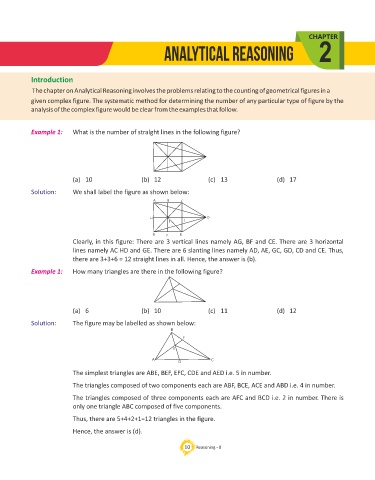
            Example 1:    What is the number of stralght lines in the following figure?


                          (a)  10                 (b)  12                (c)  13                 (d)  17

            Solution:     We shall label the figure as shown below:
                                                      A    B    C


                                                     H                   D
                                                           I     J
                                                      G    F   E
                          Clearly, in this figure: There are 3 vertical lines namely AG, BF and CE. There are 3 horizontal
                          lines namely AC HD and GE. There are 6 slanting lines namely AD, AE, GC, GD, CD and CE. Thus,
                          there are 3+3+6 = 12 straight lines in all. Hence, the answer is (b).

            Example 1:    How many triangles are there in the following figure?


                          (a)  6                  (b)  10                (c)  11                 (d)  12

            Solution:     The figure may be labelled as shown below:
                                                            B
                                                                F

                                                             E
                                                      A                   C
                                                               D
                          The simplest triangles are ABE, BEF, EFC, CDE and AED i.e. 5 in number.
                          The triangles composed of two components each are ABF, BCE, ACE and ABD i.e. 4 in number.

                          The triangles composed of three components each are AFC and BCD i.e. 2 in number. There is
                          only one triangle ABC composed of five components.

                          Thus, there are 5+4+2+1=12 triangles in the figure.
                          Hence, the answer is (d).


                                                                 5 10  Reasoning - 8

