


Page 23 - Journeys Through Society-7
P. 23
Firoz Shah Tughluq (1351 CE-1388 CE)                    Punjab occupied the throne of Delhi and founded the
            Muhammad bin Tughluq was succeeded by his cousin,       Lodi dynasty. He ruled over Delhi for 37 years.
            Firoz  Shah  Tughluq.  Firoz  could  neither  suppress
                                                                    Sikandar Lodi (1489 CE-1517 CE)
            revolts nor win back the provinces that had broken
                                                                    Sikandar  Lodi  ascended  the  throne  in  1489.  He
            away. However, he promoted agriculture, trade and
                                                                    annexed  Jaipur  and  Bihar  and  brought  the  entire
            crafts, built many new towns and patronised learning.
                                                                    region of the Gangetic plains under his control.
            After Firoz’s death in 1388 CE, the sultanate rapidly
            declined.                                               Ibrahim Lodi (1517 CE-1526 CE)

                                                                    Ibrahim Lodi was the last ruler of the Delhi Sultanate.
            Sayyid Dynasty (1414 CE-1451 CE)
                                                                    It is said that he was an arrogant ruler and treated the
            The Sayyid dynasty was established by Khizr Khan. He
                                                                    Afghan nobles with little respect. In retaliation, the
            was appointed by Timur to be the governor of Multan
                                                                    nobles  invited  Babur,  the  ruler  of  Kabul,  to  invade
            (Punjab). Khizr Khan took control over Delhi on May
                                                                    India. Babur met Lodi in the First Battle of Panipat in
            28, 1414, and founded the Sayyid dynasty. Khizr Khan
                                                                    1526  CE  and  defeated  the  latter,  leading  to  the
            was succeeded by his son, Mubarak Khan. Mubarak
                                                                    establishment of the Mughal Empire.
            Khan styled himself as Muizz-ud-Din Mubarak Shah in
            his coins. He spent most of his rule in controlling the   Administration of Delhi Sultanate
            rebellions of the nobles.
                                                                    The rule of Delhi sultanate was organised under the
            After  the  death  of  Mubarak  Khan,  his  nephew,     following:
            Muhammad  Khan  ascended  the  throne  and  styled
                                                                    •  Sultan:  The  Sultan  was  at  the  centre  of  the
            himself  as  Sultan  Muhammad  Shah.  Just  before
                                                                        sultanate administration. He protected the empire
            Muhammad Shah died, he called his son, Alauddin
                                                                        against external attacks and was responsible for
            from Badaun and nominated him as his successor. The
                                                                        maintaining  law  and  order.  He  acted  as  the
            last  ruler  of  his  dynasty,  Alauddin  Alam  Shah,
                                                                        commander-in-chief  of  the  army  and  the  chief
            voluntarily abdicated the throne in favour of Bahlul
                                                                        justice of the sultanate.
            Khan  Lodi  in  1451  CE  and  left  for  Badaun.  He
                                                                    •  Nobles and officials: The sultan was assisted by
            continued to live there until his death in 1478 CE.
                                                                        nobles  and  officials.  The  wazir  was  the  prime
                                                                        minister. The ariz-i-mamalik was responsible for
                                                                        the  ministry  of  defence.  The  diwan-i-insha  was
                                                                        responsible for the records and correspondence of
                                                                        the royal court.
                                                                    •  Army: The army of the Turks comprised infantry,
                                                                        cavalry and war elephants. The soldiers used bows
                                                                        and arrows, spears, swords, battle axes, daggers,
                                                                        shields  and  protective  headgear.  The  horseman
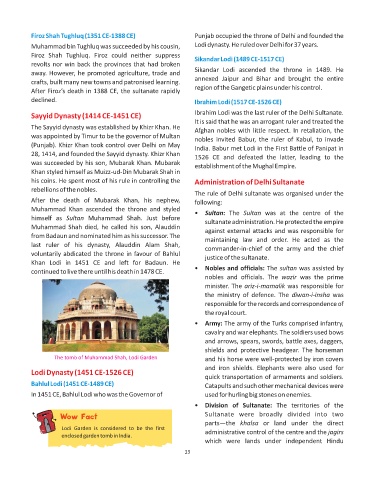
                    The tomb of Muhammad Shah, Lodi Garden              and his horse were well-protected by iron covers

                                                                        and  iron  shields.  Elephants  were  also  used  for
            Lodi Dynasty (1451 CE-1526 CE)
                                                                        quick transportation of armaments and soldiers.
            Bahlul Lodi (1451 CE-1489 CE)                               Catapults and such other mechanical devices were
            In 1451 CE, Bahlul Lodi who was the Governor of             used for hurling big stones on enemies.

                                                                    •  Division  of  Sultanate:  The  territories  of  the
                      Wow Fact                                          Sultanate  were  broadly  divided  into  two
                                                                        parts—the  khalsa  or  land  under  the  direct
                      Lodi  Garden  is  considered  to  be  the  first   administrative control of the centre and the jagirs
                      enclosed garden tomb in India.
                                                                        which  were  lands  under  independent  Hindu

                                                                 23

