


Page 86 - Journeys Through Society-7
P. 86
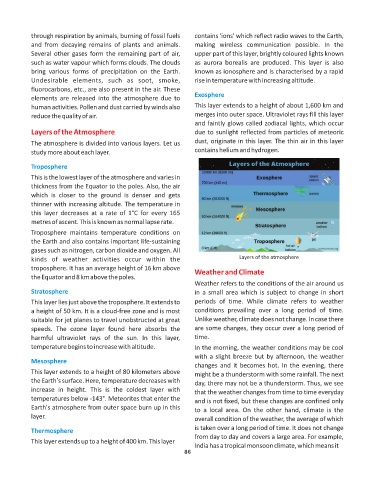
through respiration by animals, burning of fossil fuels   contains 'ions' which reflect radio waves to the Earth,
            and  from  decaying  remains  of  plants  and  animals.   making  wireless  communication  possible.  In  the
            Several other gases form the remaining part of air,     upper part of this layer, brightly coloured lights known
            such as water vapour which forms clouds. The clouds     as  aurora  borealis  are  produced.  This  layer  is  also
            bring  various  forms  of  precipitation  on  the  Earth.   known as ionosphere and is characterised by a rapid
            Undesirable  elements,  such  as  soot,  smoke,         rise in temperature with increasing altitude.
            fluorocarbons, etc., are also present in the air. These
                                                                    Exosphere
            elements  are  released  into  the  atmosphere  due  to
            human activities. Pollen and dust carried by winds also   This layer extends to a height of about 1,600 km and
            reduce the quality of air.                              merges into outer space. Ultraviolet rays fill this layer
                                                                    and faintly glows called zodiacal lights, which occur
            Layers of the Atmosphere                                due to sunlight reflected from particles of meteoric
            The atmosphere is divided into various layers. Let us   dust, originate in this layer. The thin air in this layer
            study more about each layer.                            contains helium and hydrogen.

            Troposphere

            This is the lowest layer of the atmosphere and varies in
            thickness from the Equator to the poles. Also, the air
            which  is  closer  to  the  ground  is  denser  and  gets
            thinner with increasing altitude. The temperature in
            this  layer  decreases  at  a  rate  of  1°C  for  every  165
            metres of ascent. This is known as normal lapse rate.

            Troposphere  maintains  temperature  conditions  on
            the Earth and also contains important life-sustaining
            gases such as nitrogen, carbon dioxide and oxygen. All
            kinds  of  weather  activities  occur  within  the                      Layers of the atmosphere
            troposphere. It has an average height of 16 km above
                                                                    Weather and Climate
            the Equator and 8 km above the poles.
                                                                    Weather refers to the conditions of the air around us
            Stratosphere                                            in a small area which is subject to change in short
            This layer lies just above the troposphere. It extends to   periods  of  time.  While  climate  refers  to  weather
            a height of 50 km. It is a cloud-free zone and is most   conditions  prevailing  over  a  long  period  of  time.
            suitable for jet planes to travel unobstructed at great   Unlike weather, climate does not change. In case there
            speeds.  The  ozone  layer  found  here  absorbs  the   are some changes, they occur over a long period of
            harmful  ultraviolet  rays  of  the  sun.  In  this  layer,   time.
            temperature begins to increase with altitude.           In the morning, the weather conditions may be cool
                                                                    with a slight breeze but by afternoon, the weather
            Mesosphere
                                                                    changes and it becomes hot. In the evening, there
            This layer extends to a height of 80 kilometers above   might be a thunderstorm with some rainfall. The next
            the Earth's surface. Here, temperature decreases with
                                                                    day, there may not be a thunderstorm. Thus, we see
            increase  in  height.  This  is  the  coldest  layer  with   that the weather changes from time to time everyday
            temperatures below -143°. Meteorites that enter the
                                                                    and is not fixed, but these changes are confined only
            Earth's atmosphere from outer space burn up in this     to  a  local  area.  On  the  other  hand,  climate  is  the
            layer.                                                  overall condition of the weather, the average of which

                                                                    is taken over a long period of time. It does not change
            Thermosphere
                                                                    from day to day and covers a large area. For example,
            This layer extends up to a height of 400 km. This layer
                                                                    India has a tropical monsoon climate, which means it
                                                                 86

