


Page 200 - Innovator's Science-8
P. 200
Model Test Paper-2                                                                   Chapters 8 to 13


            A.  Darken the correct option in the OMR SHEET :
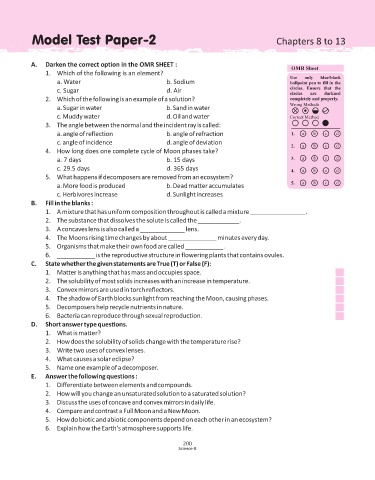
                                                                                                      OMR Sheet
                 1.   Which of the following is an element?
                     a. Water                                              b. Sodium
                     c. Sugar                                              d. Air
                 2.  Which of the following is an example of a solution?
                                                                                                     Wrong Methods
                     a. Sugar in water                               b. Sand in water
                     c. Muddy water                                  d. Oil and water                Correct Method
                 3.  The angle between the normal and the incident ray is called:
                     a. angle of reflection                          b. angle of refraction           1.  a  b   c   d
                     c. angle of incidence                           d. angle of deviation
                                                                                                      2.  a  b   c   d
                 4.  How long does one complete cycle of Moon phases take?
                     a. 7 days                                             b. 15 days                 3.  a  b   c   d
                     c. 29.5 days                                        d. 365 days
                                                                                                      4.  a  b   c   d
                 5.  What happens if decomposers are removed from an ecosystem?
                     a. More food is produced                    b. Dead matter accumulates           5.  a  b   c   d
                     c. Herbivores increase                        d. Sunlight increases
            B.   Fill in the blanks :
                 1.  A mixture that has uniform composition throughout is called a mixture ________________.
                 2.  The substance that dissolves the solute is called the ____________.
                 3.  A concaves lens is also called a _____________ lens.
                 4.  The Moons rising time changes by about ______________ minutes every day.
                 5.  Organisms that make their own food are called ___________ .
                 6.  ___________ is the reproductive structure in flowering plants that contains ovules.
            C.   State whether the given statements are True (T) or False (F):
                 1.  Matter is anything that has mass and occupies space.
                 2.  The solubility of most solids increases with an increase in temperature.
                 3.  Convex mirrors are used in torch reflectors.
                 4.  The shadow of Earth blocks sunlight from reaching the Moon, causing phases.
                 5.  Decomposers help recycle nutrients in nature.
                 6.  Bacteria can reproduce through sexual reproduction.
            D.  Short answer type ques ons.
                 1.  What is ma er?
                 2.  How does the solubility of solids change with the temperature rise?
                 3.  Write two uses of convex lenses.
                 4.  What causes a solar eclipse?
                 5.  Name one example of a decomposer.
            E.   Answer the following questions :
                 1.  Differentiate between elements and compounds.
                 2.  How will you change an unsaturated solution to a saturated solution?
                 3.  Discuss the uses of concave and convex mirrors in daily life.
                 4.  Compare and contrast a Full Moon and a New Moon.
                 5.  How do biotic and abiotic components depend on each other in an ecosystem?
                 6.  Explain how the Earth's atmosphere supports life.

                                                                200
                                                               Science-8

