


Page 14 - Journeys Through Society-7
P. 14
The events of Prithviraj’s reign have been described in   the Ganga region in Karnataka
            Prithviraj  Raso,  composed  by  his  court  poet  and   and Overran Vengi.
            friend, Chand Bardai.                                   Rajaraja    Chola    I   was
            The major Rajput dynasties were the Pratiharas, the     succeeded     by   his   son,
            Chauhanas,  the  Solankis  and  the  Paramaras.  The    Rajendra I who continued his
            Pratiharas ruled in southern Rajasthan, the Chauhans    father’s expansionist policies.
            in Shakambari, south-east of Delhi, Solanki power was   He  defeated  the  western
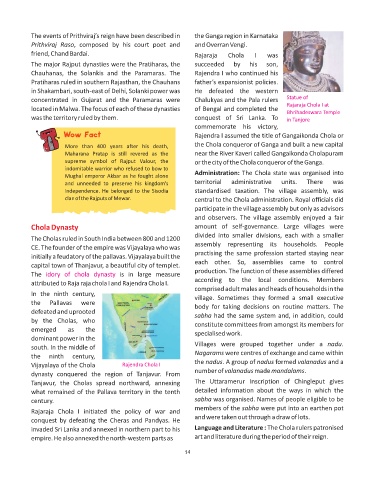
            concentrated  in  Gujarat  and  the  Paramaras  were    Chalukyas and the Pala rulers   Statue of
                                                                                                    Rajaraja Chola I at
            located in Malwa. The focus of each of these dynasties   of Bengal and completed the
                                                                                                    Bhrihadeswara Temple
            was the territory ruled by them.                        conquest  of  Sri  Lanka.  To   in Tanjore
                                                                    commemorate  his  victory,
                       Wow Fact                                     Rajendra I assumed the title of Gangaikonda Chola or

                       More  than  400  years  after  his  death,   the Chola conqueror of Ganga and built a new capital
                       Maharana  Pratap  is  still  revered  as  the   near the River Kaveri called Gangaikonda Cholapuram
                       supreme  symbol  of  Rajput  Valour,  the    or the city of the Chola conqueror of the Ganga.
                       indomitable warrior who refused to bow to
                       Mughal emperor Akbar as he fought alone      Administration: The Chola state was organised into
                       and  unneeded  to  preserve  his  kingdom’s   territorial   administrative   units.   There   was
                       independence. He belonged to the Sisodia     standardised  taxation.  The  village  assembly,  was
                       clan of the Rajputs of Mewar.                central to the Chola administration. Royal officials did
                                                                    participate in the village assembly but only as advisors
                                                                    and  observers.  The  village  assembly  enjoyed  a  fair
            Chola Dynasty                                           amount  of  self-governance.  Large  villages  were
                                                                    divided  into  smaller  divisions,  each  with  a  smaller
            The Cholas ruled in South India between 800 and 1200
                                                                    assembly  representing  its  households.  People
            CE. The founder of the empire was Vijayalaya who was
                                                                    practising the same profession started staying near
            initially a feudatory of the pallavas. Vijayalaya built the
                                                                    each  other.  So,  assemblies  came  to  control
            capital town of Thanjavur, a beautiful city of templet.
                                                                    production. The function of these assemblies differed
            The  idory  of  chola  dynasty   is  in  large  measure
                                                                    according  to  the  local  conditions.  Members
            attributed to Raja raja chola I and Rajendra Chola I.
                                                                    comprised adult males and heads of households in the
            In  the  ninth  century,
                                                                    village.  Sometimes  they  formed  a  small  executive
            the   Pallavas   were
                                                                    body  for  taking  decisions  on  routine  matters.  The
            defeated and uprooted
                                                                    sabha had the same system and, in addition, could
            by  the  Cholas,  who
                                                                    constitute committees from amongst its members for
            emerged      as    the
                                                                    specialised work.
            dominant power in the
                                                                    Villages  were  grouped  together  under  a  nadu.
            south. In the middle of
                                                                    Nagarams were centres of exchange and came within
            the   ninth   century,
                                                                    the nadus. A group of nadus formed valanadus and a
            Vijayalaya of the Chola        Rajendra Chola I
                                                                    number of valanadus made mandalams.
            dynasty  conquered  the  region  of  Tanjavur.  From
            Tanjavur,  the  Cholas  spread  northward,  annexing    The  Uttaramerur  Inscription  of  Chingleput  gives
            what remained of the Pallava territory in the tenth     detailed  information  about  the  ways  in  which  the
            century.                                                sabha was organised. Names of people eligible to be
                                                                    members of the sabha were put into an earthen pot
            Rajaraja  Chola  I  initiated  the  policy  of  war  and
                                                                    and were taken out through a draw of lots.
            conquest by defeating the Cheras and Pandyas. He
            invaded Sri Lanka and annexed in northern part to his   Language and Literature : The Chola rulers patronised
            empire. He also annexed the north-western parts as      art and literature during the period of their reign.

                                                                 14

