


Page 15 - Journeys Through Society-7
P. 15
Popular saints called nayanars and alvars, who were     high  watermark  of  achievement  in  the  field  of
            devotees of Shiva and Vishnu, respectively, flourished   sculpture.
            in Tamil region between the 6th and 9th centuries.
            Towns and Markets: Towns were known as pattanams               AI Fact
            which began as centres of exchange. Local produce                                            Technology Literacy
                                                                         The  introduction  of  Artificial  Intelligence  (AI)  and
            was  brought  to  towns.  These  towns  were
                                                                         Machine  learning  (ML)  in  archaeology  has  changed
            administrative centres as well as places of pilgrimage.      archaeology in quite a few ways. It has, in fact, made the
            A large number of people used to gather in towns.            process  of  archaeology  better  and  clearer  than  ever
            Goods were exchanged on a regular basis in towns.            before.
            Rural  markets  as  well  as  the  pattanams  were
            recognised by the administration as potential sources
            of revenue.                                             Turkish Invasion
                                                                    Mahmud  of  Ghazni  (1098-1030  CE)  also  called
                                                                    Mahmud  Ghaznavi,  was  a  Turkish  conqueror  who
                                                                    established  his  empire  in  Ghazni  (present  day
                                                                    Afghanistan).  As  part  of  his  expansionist  policy,  he
                                                                    raided India 17 times between 1001 and 1027 CE at
                                                                    places like Punjab, Mathura, Multan and Thaneshwar.
                                                                    He looted the Somnath Temple of Gujarat and took
                                                                    away the loot to Ghazni. It is said the Ghazni was never
                                                                    interested in establishing an empire in India but was
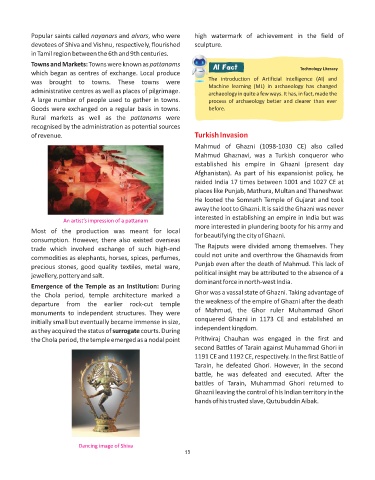
                       An artist’s impression of a pattanam
                                                                    more interested in plundering booty for his army and
            Most  of  the  production  was  meant  for  local
                                                                    for beautifying the city of Ghazni.
            consumption. However, there also existed overseas
                                                                    The  Rajputs  were  divided  among  themselves.  They
            trade  which  involved  exchange  of  such  high-end
            commodities as elephants, horses, spices, perfumes,     could not unite and overthrow the Ghaznavids from
                                                                    Punjab even after the death of Mahmud. This lack of
            precious  stones,  good  quality  textiles,  metal  ware,
                                                                    political insight may be attributed to the absence of a
            jewellery, pottery and salt.
                                                                    dominant force in north-west India.
            Emergence of the Temple as an Institution: During
                                                                    Ghor was a vassal state of Ghazni. Taking advantage of
            the  Chola  period,  temple  architecture  marked  a
                                                                    the weakness of the empire of Ghazni after the death
            departure  from  the  earlier  rock-cut  temple
                                                                    of  Mahmud,  the  Ghor  ruler  Muhammad  Ghori
            monuments  to  independent  structures.  They  were
                                                                    conquered  Ghazni  in  1173  CE  and  established  an
            initially small but eventually became immense in size,
            as they acquired the status of surrogate courts. During   independent kingdom.
            the Chola period, the temple emerged as a nodal point   Prithviraj  Chauhan  was  engaged  in  the  first  and
                                                                    second Battles of Tarain against Muhammad Ghori in
                                                                    1191 CE and 1192 CE, respectively. In the first Battle of
                                                                    Tarain,  he  defeated  Ghori.  However,  in  the  second
                                                                    battle,  he  was  defeated  and  executed.  After  the
                                                                    battles  of  Tarain,  Muhammad  Ghori  returned  to
                                                                    Ghazni leaving the control of his Indian territory in the
                                                                    hands of his trusted slave, Qutubuddin Aibak.


                            Dancing image of Shiva
                                                                 15

