


Page 162 - Journeys Through Society-7
P. 162
2.  Weavers are paid much less for making the cloth.    dollars in the US. These exporters buy the shirts at
            The  arrangement  between  the  merchant  and  the      cheaper price and sold at higher price in the US. Thus,
            weavers is an example of putting-out system, whereby    a chain of markets links the producers of cotton to the
            the merchant supplies the raw material and receives     buyers at the supermarket.
            the finished product. It is prevalent in the weaving
            industry in most regions of India.                      Market and Equality
                                                                    The foreign businesspersons made huge profits in the
                                                                    market. Compared to this, the garment exporter made
                                                                    only  moderate  profits.  On  the  other  hand,  the
                                                                    earnings of the workers at the garment export factory
                                                                    are so small that they can only cover their day-to-day
                                                                    needs.  Compared  to  the  weavers,  merchants  or
                                                                    traders earned more but it is still much less than the
                                                                    exporter. Thus, everyone did not get equal profit in the
                                                                    market.
                                                                    Usually  the  rich  and  the  powerful  people  get  the
                                                                    maximum earnings from the market. These are the
                                                                    people who have money and own the factories, the
                                                                    large shops, large landholdings, etc. The poor have to
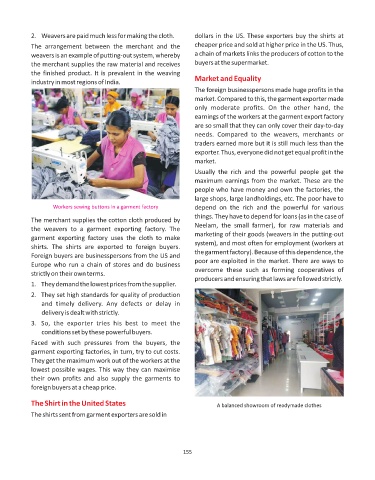
                   Workers sewing buttons in a garment factory      depend  on  the  rich  and  the  powerful  for  various
                                                                    things. They have to depend for loans (as in the case of
            The merchant supplies the cotton cloth produced by
                                                                    Neelam,  the  small  farmer),  for  raw  materials  and
            the  weavers  to  a  garment  exporting  factory.  The
                                                                    marketing of their goods (weavers in the putting-out
            garment  exporting  factory  uses  the  cloth  to  make
                                                                    system), and most often for employment (workers at
            shirts.  The  shirts  are  exported  to  foreign  buyers.
                                                                    the garment factory). Because of this dependence, the
            Foreign buyers are businesspersons from the US and
                                                                    poor are exploited in the market. There are ways to
            Europe  who  run  a  chain  of  stores and  do  business
                                                                    overcome  these  such  as  forming  cooperatives  of
            strictly on their own terms.
                                                                    producers and ensuring that laws are followed strictly.
            1.  They demand the lowest prices from the supplier.
            2.  They set high standards for quality of production
               and  timely  delivery.  Any  defects  or  delay  in
               delivery is dealt with strictly.
            3.  So,  the  exporter  tries  his  best  to  meet  the
               conditions set by these powerful buyers.
            Faced  with  such  pressures  from  the  buyers,  the
            garment exporting factories, in turn, try to cut costs.
            They get the maximum work out of the workers at the
            lowest possible wages. This way they can maximise
            their  own  profits  and  also  supply  the  garments  to
            foreign buyers at a cheap price.

            The Shirt in the United States                                  A balanced showroom of readymade clothes

            The shirts sent from garment exporters are sold in


                                                                155

