


Page 31 - Journeys Through Society-7
P. 31
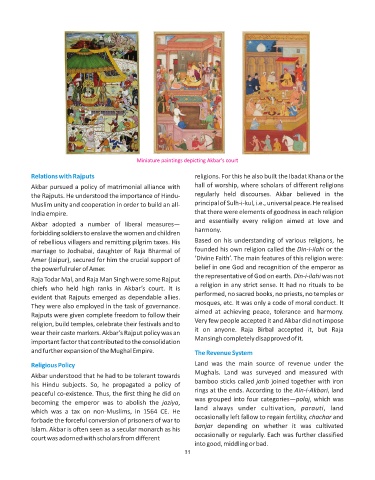
Miniature paintings depicting Akbar’s court

            Relations with Rajputs                                  religions. For this he also built the Ibadat Khana or the

            Akbar pursued a policy of matrimonial alliance with     hall of worship, where scholars of different religions
            the Rajputs. He understood the importance of Hindu-     regularly  held  discourses.  Akbar  believed  in  the
            Muslim unity and cooperation in order to build an all-  principal of Sulh-i-kul, i.e., universal peace. He realised
            India empire.                                           that there were elements of goodness in each religion
                                                                    and  essentially  every  religion  aimed  at  love  and
            Akbar  adopted  a  number  of  liberal  measures—
                                                                    harmony.
            forbidding soldiers to enslave the women and children
            of rebellious villagers and remitting pilgrim taxes. His   Based on his understanding of various religions, he
            marriage to Jodhabai, daughter of Raja Bharmal of       founded his own religion called the Din-i-ilahi or the
            Amer (Jaipur), secured for him the crucial support of   ‘Divine Faith’. The main features of this religion were:
            the powerful ruler of Amer.                             belief in one God and recognition of the emperor as
                                                                    the representative of God on earth. Din-i-ilahi was not
            Raja Todar Mal, and Raja Man Singh were some Rajput
                                                                    a religion in any strict sense. It had no rituals to be
            chiefs  who  held  high  ranks  in  Akbar’s  court.  It  is
                                                                    performed, no sacred books, no priests, no temples or
            evident that Rajputs emerged as dependable allies.
                                                                    mosques, etc. It was only a code of moral conduct. It
            They were also employed in the task of governance.
                                                                    aimed  at  achieving  peace,  tolerance  and  harmony.
            Rajputs were given complete freedom to follow their
                                                                    Very few people accepted it and Akbar did not impose
            religion, build temples, celebrate their festivals and to
                                                                    it  on  anyone.  Raja  Birbal  accepted  it,  but  Raja
            wear their caste markers. Akbar’s Rajput policy was an
                                                                    Mansingh completely disapproved of it.
            important factor that contributed to the consolidation
            and further expansion of the Mughal Empire.             The Revenue System

            Religious Policy                                        Land  was  the  main  source  of  revenue  under  the
                                                                    Mughals.  Land  was  surveyed  and  measured  with
            Akbar understood that he had to be tolerant towards
                                                                    bamboo sticks called jarib joined together with iron
            his  Hindu  subjects.  So,  he  propagated  a  policy  of
                                                                    rings at the ends. According to the Ain-i-Akbari, land
            peaceful co-existence. Thus, the first thing he did on
                                                                    was grouped into four categories—polaj, which was
            becoming  the  emperor  was  to  abolish  the  jaziya,
                                                                    land  always  under  cultivation,  parauti,  land
            which  was  a  tax  on  non-Muslims,  in  1564  CE.  He
                                                                    occasionally left fallow to regain fertility, chachar and
            forbade the forceful conversion of prisoners of war to
                                                                    banjar  depending  on  whether  it  was  cultivated
            Islam. Akbar is often seen as a secular monarch as his
                                                                    occasionally or regularly. Each was further classified
            court was adorned with scholars from different
                                                                    into good, middling or bad.
                                                                 31

