


Page 33 - Journeys Through Society-7
P. 33
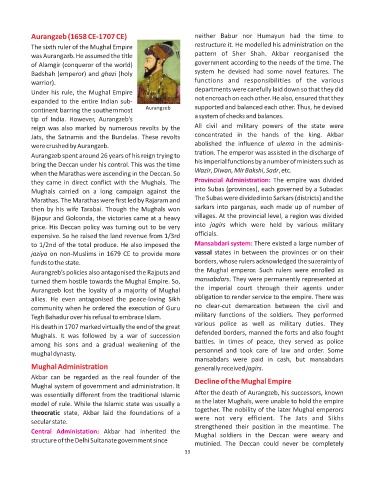
Aurangzeb (1658 CE-1707 CE)                             neither  Babur  nor  Humayun  had  the  time  to

            The sixth ruler of the Mughal Empire                    restructure it. He modelled his administration on the
            was Aurangzeb. He assumed the title                     pattern  of  Sher  Shah.  Akbar  reorganised  the
            of Alamgir (conqueror of the world)                     government according to the needs of the time. The
            Badshah (emperor) and ghazi (holy                       system  he  devised  had  some  novel  features.  The
            warrior).                                               functions  and  responsibilities  of  the  various
                                                                    departments were carefully laid down so that they did
            Under his rule, the Mughal Empire
                                                                    not encroach on each other. He also, ensured that they
            expanded to the entire Indian sub-
            continent barring the southernmost     Aurangzeb        supported and balanced each other. Thus, he devised
                                                                    a system of checks and balances.
            tip  of  India.  However,  Aurangzeb’s
            reign was also marked by numerous revolts by the        All  civil  and  military  powers  of  the  state  were
            Jats,  the  Satnamis  and  the  Bundelas.  These  revolts   concentrated  in  the  hands  of  the  king.  Akbar
            were crushed by Aurangzeb.                              abolished  the  influence  of  ulema  in  the  adminis-
                                                                    tration. The emperor was assisted in the discharge of
            Aurangzeb spent around 26 years of his reign trying to
                                                                    his imperial functions by a number of ministers such as
            bring the Deccan under his control. This was the time
                                                                    Wazir, Diwan, Mir Bakshi, Sadr, etc.
            when the Marathas were ascending in the Deccan. So
            they came in direct conflict with the Mughals. The      Provincial  Administration:  The  empire  was  divided
            Mughals  carried  on  a  long  campaign  against  the   into Subas (provinces), each governed by a Subadar.
            Marathas. The Marathas were first led by Rajaram and    The Subas were divided into Sarkars (districts) and the
            then by his wife Tarabai. Though the Mughals won        sarkars into parganas, each made up of number of
            Bijapur and Golconda, the victories came at a heavy     villages. At the provincial level, a region was divided
            price. His Deccan policy was turning out to be very     into  jagirs  which  were  held  by  various  military
            expensive. So he raised the land revenue from 1/3rd     officials.
            to 1/2nd of the total produce. He also imposed the      Mansabdari system: There existed a large number of
            jaziya on non-Muslims in 1679 CE to provide more        vassal  states  in  between  the  provinces  or  on  their
            funds to the state.                                     borders, whose rulers acknowledged the suzerainty of
            Aurangzeb’s policies also antagonised the Rajputs and   the  Mughal  emperor.  Such  rulers  were  enrolled  as
            turned them hostile towards the Mughal Empire. So,      mansabdars. They were permanently represented at
            Aurangzeb lost the loyalty of a majority of Mughal      the  imperial  court  through  their  agents  under
            allies.  He  even  antagonised  the  peace-loving  Sikh   obligation to render service to the empire. There was
            community when he ordered the execution of Guru         no  clear-cut  demarcation  between  the  civil  and
            Tegh Bahadur over his refusal to embrace Islam.         military  functions  of  the  soldiers.  They  performed
                                                                    various  police  as  well  as  military  duties.  They
            His death in 1707 marked virtually the end of the great
                                                                    defended borders, manned the forts and also fought
            Mughals.  It  was  followed  by  a  war  of  succession
                                                                    battles.  In  times  of  peace,  they  served  as  police
            among  his  sons  and  a  gradual  weakening  of  the
                                                                    personnel  and  took  care  of  law  and  order.  Some
            mughal dynasty.
                                                                    mansabdars  were  paid  in  cash,  but  mansabdars
            Mughal Administration                                   generally received jagirs.

            Akbar  can  be  regarded  as  the  real  founder  of  the
                                                                    Decline of the Mughal Empire
            Mughal system of government and administration. It
            was essentially different from the traditional Islamic   After the death of Aurangzeb, his successors, known
            model of rule. While the Islamic state was usually a    as the later Mughals, were unable to hold the empire
                                                                    together. The nobility of the later Mughal emperors
            theocratic  state,  Akbar  laid  the  foundations  of  a
                                                                    were  not  very  efficient.  The  Jats  and  Sikhs
            secular state.
                                                                    strengthened  their  position  in  the  meantime.  The
            Central  Administation:  Akbar  had  inherited  the
                                                                    Mughal  soldiers  in  the  Deccan  were  weary  and
            structure of the Delhi Sultanate government since
                                                                    mutinied.  The  Deccan  could  never  be  completely
                                                                 33

