


Page 38 - Journeys Through Society-7
P. 38
the area under forests consequently kept reducing.      tribal  nomadic  community  which  we  know  of  in
            This also led to interaction between the tribes and the   medieval times.
            villagers.  Sometimes,  these  interactions  led  to
            conflict, but most of the time it led to cooperation. The   Tribals in Medieval India
            forest-dwellers  often  exchanged  their  ghee,  honey,   The  medieval  Indian  tribes  generally  practised
            wool, medicinal herbs, etc., for grain, cotton, utensils,   primitive cultivation, herding and hunting-gathering.
            jewellery and furniture owned by the villagers. This    While some tribes were nomads. In medieval period,
            economic  interdependence  also  led  to  the           with  the  expansion  of  trade  and  war,  the  Mughal
            assimilation  of  cultures,  customs  and  religious    armies often came in contact with the tribals. Some of
            ceremonies of the tribals into the main society.        the tribes rose to prominence and they paid tribute to
                                                                    the Mughal emperors.
            Main Characteristics of Tribal Societies
            Tribal communities have certain distinct characteris-
            tics. Some of these are as follows:
            1.  There is a lack of distinction between form and
               substance of religion.
            2.  They have a very basic sense of economics.

            3.  Relationship  binds  the  members  of  the
               community.
            4.  Land belongs to the entire community.
            5.  Unlike the varna and jati based system, there does
               not exist a hierarchy among tribals.

            6.  There  is  an  absence  of  strong,  complex,  formal
               government or state system.

            How Tribal Societies are Organised?
            The tribal society was organised on democratic and
            cooperative lines. Kinship bonds were very important
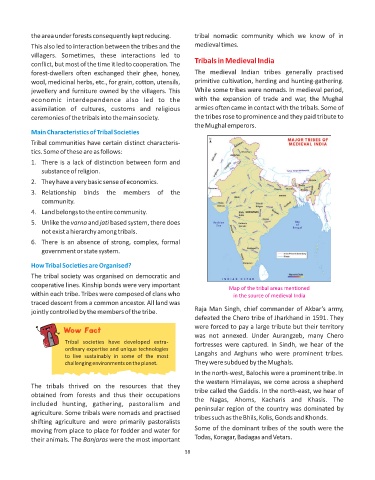
                                                                                Map of the tribal areas mentioned
            within each tribe. Tribes were composed of clans who                  in the source of medieval India
            traced descent from a common ancestor. All land was
                                                                    Raja Man Singh, chief commander of Akbar’s army,
            jointly controlled by the members of the tribe.
                                                                    defeated the Chero tribe of Jharkhand in 1591. They
                       Wow Fact                                     were forced to pay a large tribute but their territory
                                                                    was  not  annexed.  Under  Aurangzeb,  many  Chero
                       Tribal  societies  have  developed  extra-   fortresses were captured. In Sindh, we hear of the
                       ordinary expertise and unique technologies   Langahs  and  Arghuns  who  were  prominent  tribes.
                       to  live  sustainably  in  some  of  the  most
                       challenging environments on the planet.      They were subdued by the Mughals.
                                                                    In the north-west, Balochis were a prominent tribe. In
                                                                    the western Himalayas, we come across a shepherd
            The  tribals  thrived  on  the  resources  that  they
                                                                    tribe called the Gaddis. In the north-east, we hear of
            obtained  from  forests  and  thus  their  occupations
                                                                    the  Nagas,  Ahoms,  Kacharis  and  Khasis.  The
            included  hunting,  gathering,  pastoralism  and
                                                                    peninsular region of the country was dominated by
            agriculture. Some tribals were nomads and practised
                                                                    tribes such as the Bhils, Kolis, Gonds and Khonds.
            shifting  agriculture  and  were  primarily  pastoralists
                                                                    Some of the dominant tribes of the south were the
            moving from place to place for fodder and water for
            their animals. The Banjaras were the most important     Todas, Koragar, Badagas and Vetars.

                                                                 38

