


Page 40 - Journeys Through Society-7
P. 40
Wow Fact                                       Ahom ruler to adopt a Hindu name, Swarga narayan.
                                                                    However, the Ahom power in Assam reached its peak
                      An interesting feature of the Gond lifestyle   during the reign of King Rudra Singh (1696-1714) who
                      was the ghotul or the dormitory system. Here
                      unmarried  boys  and  girls  led  a  highly   came in conflict with the Mughal ruler Aurangzeb. The
                      organised life and received training in leading   British  overthrew  the  Ahoms  in  the  nineteenth
                      a dutiful life.                               century.


                                                                    Society and Culture
            inhabitants  of  the  region.  The  Ahoms  ruled  over
                                                                    The Ahoms were a tribal community and followed the
            Assam for about 600 years, from 1228 CE to 1826 CE.     tribal way of life. They practised agriculture and rice
                                                                    was their main crop. Though some Ahoms adopted
            The Ahom Kingdom
                                                                    Hinduism as their religion, yet the prevalent practice
            The Ahom kingdom was divided into provinces and
                                                                    was  to  follow  the  traditional  beliefs  marked  by
            the  kings  governed  with  the  help  of  a  council  of
                                                                    ancestor worship.
            ministers called the patro montris.
                                                                    The  influence  of  Brahmins  increased  during  the
            The first Ahom leader was
                                                                    seventeenth  century.  But  even  though  the  Ahoms
            Sukaphaa, Tai prince who,
                                                                    built  Hindu  temples,  with  Hindu  priests,  they
            along  with  his  followers,
                                                                    continued to worship their tribal gods. They also used
            crossed the Patkai Hills in
                                                                    their tribal language and followed their tribal customs.
            the  mid-thirteen  century
            and    settled   in   the
            Brahmaputra     area   by
            establishing  his  capital  at
            Charaideo  near  Shivsagar.
            It was under his leadership
            that  the  dispersed  tribal
            groups    were    brought
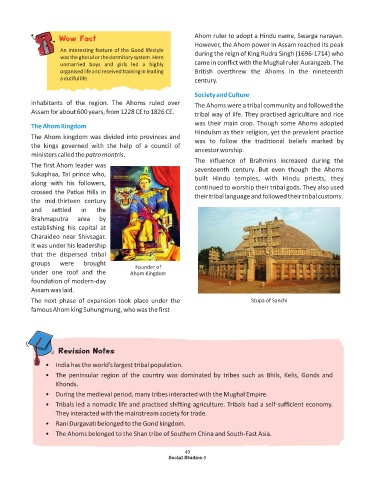
                                                Founder of
            under  one  roof  and  the        Ahom Kingdom
            foundation of modern-day
            Assam was laid.
            The  next  phase  of  expansion  took  place  under  the                    Stupa of Sanchi
            famous Ahom king Suhungmung, who was the first


                     Revision Notes


                 •  India has the world’s largest tribal population.
                 •  The  peninsular  region  of  the  country  was  dominated  by  tribes  such  as  Bhils,  Kelis,  Gonds  and
                    Khonds.
                 •  During the medieval period, many tribes interacted with the Mughal Empire.
                 •  Tribals led a nomadic life and practised shifting agriculture. Tribals had a self-sufficient economy.
                    They interacted with the mainstream society for trade.

                 •  Rani Durgavati belonged to the Gond kingdom.
                 •  The Ahoms belonged to the Shan tribe of Southern China and South-East Asia.


                                                                 40
                                                           Social Studies-7

