


Page 45 - Journeys Through Society-7
P. 45
lower castes. He was an ardent supporter of Hindu-                  Wow Fact
            Muslim unity and his disciples belonged to both the
                                                                                According  to  a  legend,  Tulsidas  took  12
            communities.                                                        months to come out of his mother’s womb,

            The followers of Kabir formed a group which came to                 and had 32 teeth from birth. According to a
            be known as Kabirpanthis. His words were put down in                popular belief instead of crying after birth he
                                                                                chanted  ‘Ram’.  Therefore  he  was  named
            writings called Kabirvani. Later on his philosophy was
                                                                                Rambola, after the name of Shri Ram.
            composed as Kabir Granthavali and Bijak.
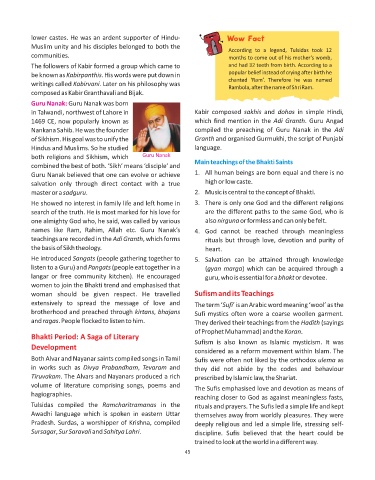
            Guru Nanak: Guru Nanak was born
            in Talwandi, northwest of Lahore in                     Kabir  composed  sakhis  and  dohas  in  simple  Hindi,
            1469 CE, now popularly known as                         which find mention in the Adi Granth. Guru Angad
            Nankana Sahib. He was the founder                       compiled  the  preaching  of  Guru  Nanak  in  the  Adi
            of Sikhism. His goal was to unify the                   Granth and organised Gurmukhi, the script of Punjabi
            Hindus and Muslims. So he studied                       language.
            both religions and Sikhism, which     Guru Nanak
                                                                    Main teachings of the Bhakti Saints
            combined the best of both. ‘Sikh’ means ‘disciple’ and
            Guru Nanak believed that one can evolve or achieve      1.  All human beings are born equal and there is no
            salvation  only  through  direct  contact  with  a  true    high or low caste.
            master or a sadguru.                                    2.  Music is central to the concept of Bhakti.
            He showed no interest in family life and left home in   3.  There is only one God and the different religions
            search of the truth. He is most marked for his love for     are the different paths to the same God, who is
            one almighty God who, he said, was called by various        also nirguna or formless and can only be felt.
            names  like  Ram,  Rahim,  Allah  etc.  Guru  Nanak’s   4.  God  cannot  be  reached  through  meaningless
            teachings are recorded in the Adi Granth, which forms       rituals but through love, devotion and purity of
            the basis of Sikh theology.                                 heart.
            He introduced Sangats (people gathering together to     5.  Salvation  can  be  attained  through  knowledge
            listen to a Guru) and Pangats (people eat together in a     (gyan marga) which can be acquired through a
            langar  or  free  community  kitchen).  He  encouraged      guru, who is essential for a bhakt or devotee.
            women to join the Bhakti trend and emphasised that
            woman  should  be  given  respect.  He  travelled       Sufism and its Teachings
            extensively  to  spread  the  message  of  love  and    The term ‘Sufi’ is an Arabic word meaning ‘wool’ as the
            brotherhood and preached through kirtans, bhajans       Sufi  mystics  often  wore  a  coarse  woollen  garment.
            and ragas. People flocked to listen to him.             They derived their teachings from the Hadith (sayings

                                                                    of Prophet Muhammad) and the Koran.
            Bhakti Period: A Saga of Literary
                                                                    Sufism  is  also  known  as  Islamic  mysticism.  It  was
            Development
                                                                    considered as a reform movement within Islam. The
            Both Alvar and Nayanar saints compiled songs in Tamil   Sufis were often not liked by the orthodox ulema as
            in  works  such  as  Divya  Prabandham,  Tevaram  and   they  did  not  abide  by  the  codes  and  behaviour
            Tiruvakam. The Alvars and Nayanars produced a rich      prescribed by Islamic law, the Shariat.
            volume  of  literature  comprising  songs,  poems  and
                                                                    The Sufis emphasised love and devotion as means of
            hagiographies.
                                                                    reaching closer to God as against meaningless fasts,
            Tulsidas  compiled  the  Ramcharitramanas  in  the      rituals and prayers. The Sufis led a simple life and kept
            Awadhi  language  which  is  spoken  in  eastern  Uttar   themselves away from worldly pleasures. They were
            Pradesh. Surdas, a worshipper of Krishna, compiled      deeply religious and led a simple life, stressing self-
            Sursagar, Sur Saravali and Sahitya Lahri.               discipline.  Sufis  believed  that  the  heart  could  be

                                                                    trained to look at the world in a different way.
                                                                 45

