


Page 51 - Journeys Through Society-7
P. 51
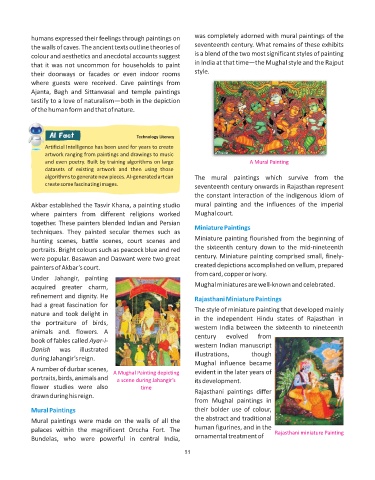
was completely adorned with mural paintings of the
            humans expressed their feelings through paintings on
            the walls of caves. The ancient texts outline theories of   seventeenth century. What remains of these exhibits
                                                                    is a blend of the two most significant styles of painting
            colour and aesthetics and anecdotal accounts suggest
            that it was not uncommon for households to paint        in India at that time—the Mughal style and the Rajput
            their  doorways  or  facades  or  even  indoor  rooms   style.
            where  guests  were  received.  Cave  paintings  from
            Ajanta,  Bagh  and  Sittanvasal  and  temple  paintings
            testify to a love of naturalism—both in the depiction
            of the human form and that of nature.


                  AI Fact                       Technology Literacy

                 Artificial Intelligence has been used for years to create
                 artwork ranging from paintings and drawings to music
                 and even poetry. Built by training algorithms on large                A Mural Painting
                 datasets  of  existing  artwork  and  then  using  those
                 algorithms to generate new pieces. AI-generated art can   The  mural  paintings  which  survive  from  the
                 create some fascinating images.                    seventeenth century onwards in Rajasthan represent

                                                                    the constant interaction of the indigenous idiom of
            Akbar established the Tasvir Khana, a painting studio   mural  painting  and  the  influences  of  the  imperial
            where  painters  from  different  religions  worked     Mughal court.
            together. These painters blended Indian and Persian
                                                                    Miniature Paintings
            techniques.  They  painted  secular  themes  such  as
            hunting  scenes,  battle  scenes,  court  scenes  and   Miniature painting flourished from the beginning of
                                                                    the  sixteenth  century  down  to  the  mid-nineteenth
            portraits. Bright colours such as peacock blue and red
            were popular. Basawan and Daswant were two great        century. Miniature painting comprised small, finely-
            painters of Akbar’s court.                              created depictions accomplished on vellum, prepared
                                                                    from card, copper or ivory.
            Under  Jahangir,  painting
            acquired  greater  charm,                               Mughal miniatures are well-known and celebrated.
            refinement and dignity. He
                                                                    Rajasthani Miniature Paintings
            had a great fascination for
                                                                    The style of miniature painting that developed mainly
            nature and took delight in
                                                                    in  the  independent  Hindu  states  of  Rajasthan  in
            the  portraiture  of  birds,
                                                                    western India between the sixteenth to nineteenth
            animals  and.  flowers.  A
                                                                    century    evolved    from
            book of fables called Ayar-i-
                                                                    western Indian manuscript
            Danish    was    illustrated
                                                                    illustrations,      though
            during Jahangir’s reign.
                                                                    Mughal  influence  became
            A number of durbar scenes,
                                        A Mughal Painting depicting   evident in the later years of
            portraits, birds, animals and   a scene during Jahangir’s   its development.
            flower  studies  were  also           time
            drawn during his reign.                                 Rajasthani  paintings  differ
                                                                    from  Mughal  paintings  in
            Mural Paintings                                         their  bolder  use  of  colour,
                                                                    the abstract and traditional
            Mural  paintings  were  made  on  the  walls  of  all  the
            palaces  within  the  magnificent  Orccha  Fort.  The   human figurines, and in the   Rajasthani miniature Painting
            Bundelas,  who  were  powerful  in  central  India,     ornamental treatment of

                                                                 51

