


Page 52 - Journeys Through Society-7
P. 52
the  landscape.  The  themes  depicted  included  the   Architecture
            legends of Krishna and Radha.                           The medieval buildings (temples) of Bengal show a
                                                                    distinctive architectural style. What is noteworthy in
            Pahari Painting
                                                                    these buildings is the extensive use of terracotta and
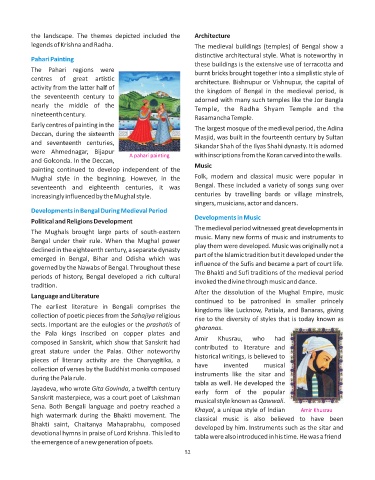
            The  Pahari  regions  were
                                                                    burnt bricks brought together into a simplistic style of
            centres  of  great  artistic
                                                                    architecture. Bishnupur or Vishnupur, the capital of
            activity from the latter half of
                                                                    the  kingdom  of  Bengal  in  the  medieval  period,  is
            the  seventeenth  century  to
                                                                    adorned with many such temples like the Jor Bangla
            nearly  the  middle  of  the
                                                                    Temple,  the  Radha  Shyam  Temple  and  the
            nineteenth century.
                                                                    Rasamancha Temple.
            Early centres of painting in the
                                                                    The largest mosque of the medieval period, the Adina
            Deccan, during the sixteenth
                                                                    Masjid, was built in the fourteenth century by Sultan
            and  seventeenth  centuries,
                                                                    Sikandar Shah of the Ilyas Shahi dynasty. It is adorned
            were  Ahmednagar,  Bijapur
                                              A pahari painting     with inscriptions from the Koran carved into the walls.
            and Golconda. In the Deccan,
                                                                    Music
            painting  continued  to  develop  independent  of  the
            Mughal  style  in  the  beginning.  However,  in  the   Folk,  modern  and  classical  music  were  popular  in
            seventeenth  and  eighteenth  centuries,  it  was       Bengal. These included a variety of songs sung over
            increasingly influenced by the Mughal style.            centuries  by  travelling  bards  or  village  minstrels,
                                                                    singers, musicians, actor and dancers.
            Developments in Bengal During Medieval Period
                                                                    Developments in Music
            Political and Religions Development
                                                                    The medieval period witnessed great developments in
            The  Mughals  brought  large  parts  of  south-eastern
                                                                    music. Many new forms of music and instruments to
            Bengal  under  their  rule.  When  the  Mughal  power
                                                                    play them were developed. Music was originally not a
            declined in the eighteenth century, a separate dynasty
                                                                    part of the Islamic tradition but it developed under the
            emerged  in  Bengal,  Bihar  and  Odisha  which  was
                                                                    influence of the Sufis and became a part of court life.
            governed by the Nawabs of Bengal. Throughout these
                                                                    The Bhakti and Sufi traditions of the medieval period
            periods of history, Bengal developed a rich cultural
                                                                    invoked the divine through music and dance.
            tradition.
                                                                    After  the  dissolution  of  the  Mughal  Empire,  music
            Language and Literature
                                                                    continued  to  be  patronised  in  smaller  princely
            The  earliest  literature  in  Bengali  comprises  the
                                                                    kingdoms like Lucknow, Patiala, and Banaras, giving
            collection of poetic pieces from the Sahajiya religious
                                                                    rise to the diversity of styles that is today known as
            sects. Important are the eulogies or the prashatis of
                                                                    gharanas.
            the  Pala  kings  inscribed  on  copper  plates  and
                                                                    Amir    Khusrau,    who     had
            composed in Sanskrit, which show that Sanskrit had
                                                                    contributed  to  literature  and
            great  stature  under  the  Palas.  Other  noteworthy
                                                                    historical writings, is believed to
            pieces  of  literary  activity  are  the  Charyagitika,  a
                                                                    have      invented      musical
            collection of verses by the Buddhist monks composed
                                                                    instruments  like  the  sitar  and
            during the Pala rule.
                                                                    tabla as well. He developed the
            Jayadeva, who wrote Gita Govinda, a twelfth century
                                                                    early  form  of  the  popular
            Sanskrit masterpiece, was a court poet of Lakshman
                                                                    musical style known as Qawwali.
            Sena.  Both  Bengali  language  and  poetry  reached  a
                                                                    Khayal, a unique style of Indian     Amir Khusrau
            high  watermark  during  the  Bhakti  movement.  The
                                                                    classical  music  is  also  believed  to  have  been
            Bhakti  saint,  Chaitanya  Mahaprabhu,  composed
                                                                    developed by him. Instruments such as the sitar and
            devotional hymns in praise of Lord Krishna. This led to
                                                                    tabla were also introduced in his time. He was a friend
            the emergence of a new generation of poets.
                                                                 52

