


Page 7 - Journeys Through Society-7
P. 7
3. Literary Accounts                                    Polo  and  Nicolo  Conti,  both  of
            4. Archaeological sources                               whom were from Italy. The latter
                                                                    left  a  significant  account  of  the
            Literary Sources                                        kingdom  of  Vijayanagar  and  its
            Literary sources constitute the body of written records   wars with the Bahamani kingdom.
            in the form of chronicles, commentaries, royal orders,   Ralph  Fitch  wrote  a  graphic
            farmans,    folklores,   dramas,   autobiographies,     account  of  the  court  of  Akbar.  A
            biographies, etc. The literary sources of the early part   number  of  European  travellers    Marco Polo
            of  medieval  India  are  found  in  the  form  of      visited the court of Jahangir. Father
            manuscripts.  Manuscripts  are  handwritten  records    Xavier, Captain William Hawkins and Sir Thomas Roe
            preserved in archives. The literary texts are divided   were among them.
            into various categories, for instance, the indigenous   The travelogues of this period are another important
            and  foreign  accounts.  Another  category  of  literary   source.  Ibn  Battuta's  Rihla  describes  the  reign  of
            sources  are  the  religious  records  left  by  religious   Muhammad  bin  Tughluq.  Abdur  Razzaq  wrote  an
            teachers, reformers and their disciples.                account  on  the  conditions  of  the  kingdom  of

            It is interesting to note that paper was still not in use in   Vijayanagar.
            the  Indian  subcontinent  during  the  early  medieval
                                                                    Archaeological Sources
            period. Palm leaves, bark of birch trees and animal
            skins were used as materials for writing.               Archaeology  is  the  study  of  History  through  the
                                                                    material remains of human life.
            Biographies  like  Barani’s  Tarikh-i-Firozshahi,  Abul
            Fazl’s  Ain-i-Akbari,  and  Muntakhabul-Tawarikh  by    Archaeological sources may include old monuments
            Badauni  are  some  important  sources.  Other          like  palaces,  temples,  buildings,  coins,  inscriptions,
            important works are Prithviraj-raso of Chand Bardai,    etc.  These  are  generally  obtained  by  digging  the
            Bilhana's  Vikramankadeva  Charita  and  Kalhana's      surface of the earth. The people who study such old
            Rajatarangini.                                          material remains are called archaeologists.

            Royal  orders  and  farmans  issued  by  the  court  of   Monuments, old buildings and artefacts tell us about
            Jahangir and Aurangzeb also throw valuable light on     the  social  and  economic  life  of  the  people.  They
            the workings of the Mughal administration.              provide  invaluable  information  regarding  the
                                                                    architectural skills of workers, the materials used to
                                                                    construct  these  monuments  and  the  modes  of
                                                                    transportation in use besides the cultural and religious
                                                                    beliefs prevalent during the period under study. Some
                                                                    important archaeological sources of this period are
                                                                    the Agra Fort in Agra, the Red Fort in Delhi, the Amber
                                                                    Fort in Jaipur and the Fort of Jaisalmer.


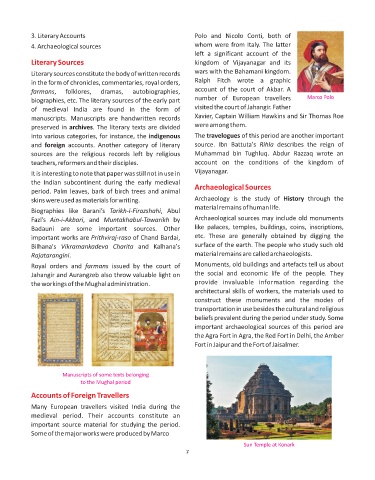
                       Manuscripts of some texts belonging
                             to the Mughal period
            Accounts of Foreign Travellers

            Many  European  travellers  visited  India  during  the
            medieval  period.  Their  accounts  constitute  an
            important  source  material  for  studying  the  period.
            Some of the major works were produced by Marco
                                                                                     Sun Temple at Konark
                                                                 7

