


Page 95 - Journeys Through Society-7
P. 95
Strong winds do not blow continuously with the same
            degree of intensity and, after a while, they become
            gentle before regaining force once again. Sometimes
            when the wind blows, it forms whirls of dust or eddies.
            It especially takes place in areas where there are tall
            buildings. When the eddies lie in the direction of the
            winds, the winds become strong.
            Winds  may  be  broadly  classified  into  the  following
            four categories:
            Permanent  Winds:  These  winds  blow  the  all  year
            round in a fixed direction. Trade winds that come from
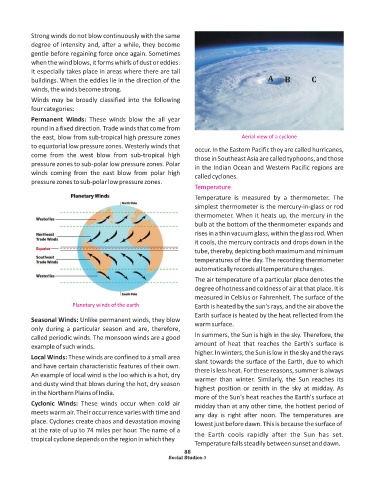
            the east, blow from sub-tropical high pressure zones                     Aerial view of a cyclone
            to equatorial low pressure zones. Westerly winds that
                                                                    occur. In the Eastern Pacific they are called hurricanes,
            come  from  the  west  blow  from  sub-tropical  high
                                                                    those in Southeast Asia are called typhoons, and those
            pressure zones to sub-polar low pressure zones. Polar
                                                                    in the Indian Ocean and Western Pacific regions are
            winds  coming  from  the  east  blow  from  polar  high
                                                                    called cyclones.
            pressure zones to sub-polar low pressure zones.
                                                                    Temperature
                                                                    Temperature  is  measured  by  a  thermometer.  The
                                                                    simplest thermometer is the mercury-in-glass or rod
                                                                    thermometer. When it heats up, the mercury in the
                                                                    bulb at the bottom of the thermometer expands and
                                                                    rises in a thin vacuum glass, within the glass rod. When
                                                                    it cools, the mercury contracts and drops down in the
                                                                    tube, thereby, depicting both maximum and minimum
                                                                    temperatures of the day. The recording thermometer
                                                                    automatically records all temperature changes.

                                                                    The air temperature of a particular place denotes the
                                                                    degree of hotness and coldness of air at that place. It is
                                                                    measured in Celsius or Fahrenheit. The surface of the
                          Planetary winds of the earth              Earth is heated by the sun's rays, and the air above the
                                                                    Earth surface is heated by the heat reflected from the
            Seasonal Winds: Unlike permanent winds, they blow
                                                                    warm surface.
            only  during  a  particular  season  and  are,  therefore,
                                                                    In summers, the Sun is high in the sky. Therefore, the
            called periodic winds. The monsoon winds are a good
                                                                    amount  of  heat  that  reaches  the  Earth's  surface  is
            example of such winds.
                                                                    higher. In winters, the Sun is low in the sky and the rays
            Local Winds: These winds are confined to a small area
                                                                    slant towards the surface of the Earth, due to which
            and have certain characteristic features of their own.
                                                                    there is less heat. For these reasons, summer is always
            An example of local wind is the loo which is a hot, dry
                                                                    warmer  than  winter.  Similarly,  the  Sun  reaches  its
            and dusty wind that blows during the hot, dry season
                                                                    highest  position  or  zenith  in  the  sky  at  midday.  As
            in the Northern Plains of India.
                                                                    more of the Sun's heat reaches the Earth's surface at
            Cyclonic  Winds:  These  winds  occur  when  cold  air   midday than at any other time, the hottest period of
            meets warm air. Their occurrence varies with time and
                                                                    any  day  is  right  after  noon.  The  temperatures  are
            place. Cyclones create chaos and devastation moving
                                                                    lowest just before dawn. This is because the surface of
            at the rate of up to 74 miles per hour. The name of a
                                                                    the  Earth  cools  rapidly  after  the  Sun  has  set.
            tropical cyclone depends on the region in which they
                                                                    Temperature falls steadily between sunset and dawn.
                                                                 88
                                                           Social Studies-7

