


Page 96 - Journeys Through Society-7
P. 96
Saturation point: Air can hold only a certain amount of   become too heavy to remain suspended in the air and
            water vapour at a given temperature. When the air       fall  to  the  surface.  When  warm  moist  air  cools,  it
            reaches its full capacity of holding water vapour, it is   condenses to form thick clouds which bring rainfall in
            said  to  be  saturated.  As  the  temperature  of  the   the form of large drops of water. When the drops are
            saturated air falls, the water vapour in it condenses to   small, it is called drizzle. Rainfall is measured by an
            form droplets of water which float in the air. Millions   instrument called the rain gauge.
            of such droplets together form clouds, which are kept   In regions where hot air expands to rise up to high
            from  falling  by  air  currents.  Clouds  are  grouped   altitudes, it forms thick clouds that cause a sudden
            according to their shape and height. Some examples      torrential rainfall called convectional rainfall. When
            of  different  types  of  clouds  are  stratus,  cirrus  and   high mountains come in the way of moist winds and
            cumulus. Altitude affects the shape of clouds. As air   force them to rise up their slopes and shed rainfall, it is
            rises, it cools and clouds are formed but when the air   known as relief or orographic rainfall. When warm and
            descends from a great height, it gets warmer and the    cold air meet, the lighter warm air ascends over the
            clouds disappear.                                       heavier cold air, condensing above it and resulting in
            Precipitation                                           cyclonic rainfall.

            Precipitation is any form of water, in solid or liquid   Snow is made up of flakes of tiny ice crystals that form
            state, that falls on the Earth's surface. Precipitation   a snow cloud.
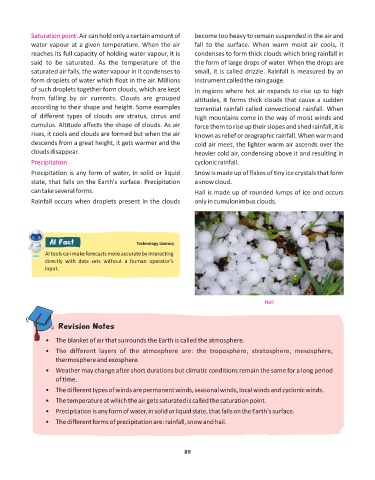
            can take several forms.                                 Hail is made up of rounded lumps of ice and occurs

            Rainfall occurs when droplets present in the clouds     only in cumulonimbus clouds.


                  AI Fact                       Technology Literacy

                 AI tools can make forecasts more accurate by interacting
                 directly  with  data  sets  without  a  human  operator’s
                 input.


                                                                                            Hail


                     Revision Notes


                 •  The blanket of air that surrounds the Earth is called the atmosphere.
                 •  The  different  layers  of  the  atmosphere  are:  the  troposphere,  stratosphere,  mesosphere,
                    thermosphere and exosphere.
                 •  Weather may change after short durations but climatic conditions remain the same for a long period
                    of time.
                 •  The different types of winds are permanent winds, seasonal winds, local winds and cyclonic winds.

                 •  The temperature at which the air gets saturated is called the saturation point.
                 •  Precipitation is any form of water, in solid or liquid state, that falls on the Earth's surface.
                 •  The different forms of precipitation are: rainfall, snow and hail.


                                                                 89

