


Page 73 - Code Craft Computer-7
P. 73
Flashback Time


                    ¨  The word ethics refers to moral standards and principles that govern the conduct and behaviour
                       of an individual.

                    ¨  Cybercrime refers to an unethical or illegal activity that involves a computer and a network.
                    ¨  Spamming refers to sending unsolicited bulk emails indiscriminately. Mostly, spam carry
                       advertisements.
                    ¨  Cyberstalking refers to a crime that uses Internet or a computer to stalk or harass a group, an
                       organisation, and particularly an individual. Cyberstalking is also known as e-stalking.
                    ¨  A person who commits a crime of cyber stalking is known as a cyberstalker.
                    ¨  The act of harassing, embarrassing, threatening, or targeting a person using a computer and
                       Internet is called cyberbullying. Cyberbullying is also known as cyber harassment or online
                       bullying.
                    ¨  Intellectual property refers to the rights given to people over creations of the mind.
                    ¨  A copyright is a legal term that protects the rights of literary, dramatic, musical, artistic, and
                       original works.
                    ¨  The act of stealing someone else's intellectual property is known as plagiarism.
                    ¨  Computer Virus stands for Vital Information Resources Under Seize.
                    ¨  Cyberterrorism occurs against organisations, individuals, business houses, and even against
                       government establishments.


                      Knowledge Check


              A.     Mark the correct response.

                     1.    ____________  refers  to  an  unethical  or  illegal  activity  that   OMR Sheet
                           involves a computer and a network.                                  Use only blue/black ball
                                                                                               pen to fill the circles. It
                           a. Cybercrime                      b. Cyberstalking                 should   be   darkened
                                                                                               completely and properly.
                           c.  Spamming                       d. Plagiarism
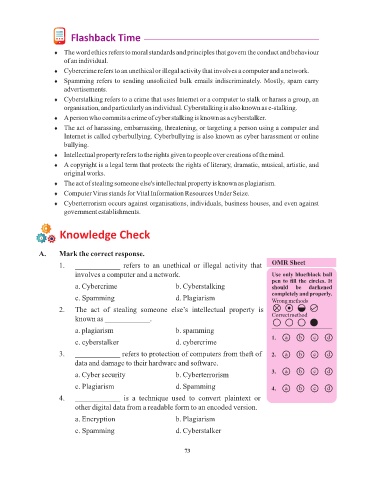
                                                                                               Wrong methods
                     2.    The  act  of  stealing  someone  else’s  intellectual  property  is
                                                                                               Correct method
                           known as ____________.
                           a. plagiarism                      b. spamming
                                                                                               1.   a   b    c    d
                           c.  cyberstalker                   d. cybercrime

                     3.    ____________ refers to protection of computers from theft of        2.   a   b    c    d
                           data and damage to their hardware and software.
                                                                                               3.   a   b    c    d
                           a. Cyber security                  b. Cyberterrorism
                           c.  Plagiarism                     d. Spamming                      4.   a   b    c    d
                     4.    ____________  is  a  technique  used  to  convert  plaintext  or
                           other digital data from a readable form to an encoded version.

                           a. Encryption                      b. Plagiarism
                           c.  Spamming                       d. Cyberstalker


                                                                 73

