


Page 108 - Code Craft Computer-8
P. 108
of queries that help us achieve various objectives and better decision-making. These questions
            can be divided into the following categories:

            1. What would be the class of the given item?
            In this category, a question related to the class of an item is asked, for example, what would be the

            class of a given item, either A or B. For example        , for the question "Will you go to the party
            today?" the answer would be a yes or no.
            In this category, the answer would be in some definite form. Some more examples of this type of
            question are:

            •    Whether the tea is cold or hot?
            •    Whether it is a dog or cat?

            •    Whether it is an apple or a mango?
            •    Are you diabetic?

            To give answers to such types of questions, classification algorithms are used.
            Classification is a method which is used to classify the output into a finite number of classes. The
            number of output classes may be two or more than two.
            If the number of output classes is two, then the classification is called binary      classification, and in

            the case where you have more than two classes, it is called multi-class      classification.

            2. Is this an outlier?
            An outlier means an object whose features are not similar to those of
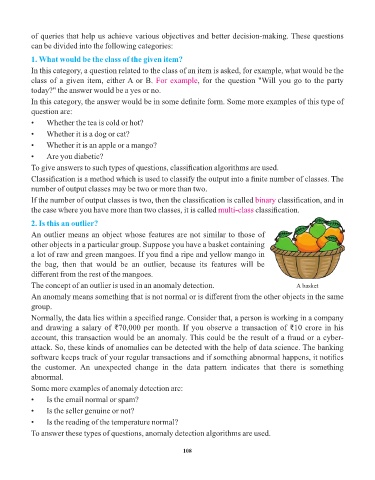
            other objects in a particular group. Suppose you have a basket containing
            a lot of raw and green mangoes. If you find a ripe and yellow mango in
            the  bag,  then  that  would  be  an  outlier,  because  its  features  will  be
            different from the rest of the mangoes.

            The concept of an outlier is used in an anomaly detection.                                 A basket
            An anomaly means something that is not normal or is different from the other objects in the same
            group.

            Normally, the data lies within a specified range. Consider that, a person is working in a company
            and drawing a salary of ₹70,000 per month. If you observe a transaction of ₹10 crore in his
            account, this transaction would be an anomaly. This could be the result of a fraud or a cyber-
            attack. So, these kinds of anomalies can be detected with the help of data science. The banking
            software keeps track of your regular transactions and if something abnormal happens, it notifies
            the  customer.  An  unexpected  change  in  the  data  pattern  indicates  that  there  is  something

            abnormal.
            Some more examples of anomaly detection are:

            •    Is the email normal or spam?
            •    Is the seller genuine or not?
            •    Is the reading of the temperature normal?

            To answer these types of questions, anomaly detection algorithms are used.


                                                                108

