


Page 11 - Code Craft Computer-8
P. 11
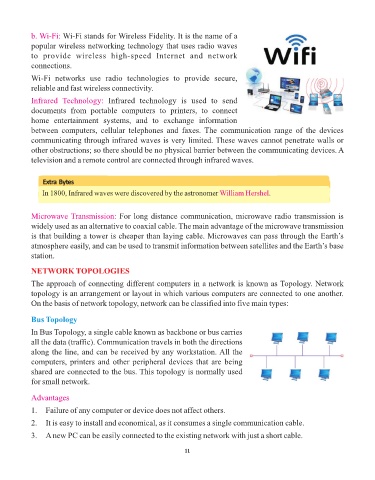
b. Wi-Fi: Wi-Fi stands for Wireless Fidelity. It is the name of a
            popular wireless networking technology that uses radio waves
            to  provide  wireless  high-speed  Internet  and  network

            connections.
            Wi-Fi  networks  use  radio  technologies  to  provide  secure,
            reliable and fast wireless connectivity.

            Infrared  Technology:  Infrared  technology  is  used  to  send
            documents  from  portable  computers  to  printers,  to  connect
            home  entertainment  systems,  and  to  exchange  information

            between  computers,  cellular  telephones  and  faxes.  The  communication  range  of  the  devices
            communicating through infrared waves is very limited. These waves cannot penetrate walls or
            other obstructions; so there should be no physical barrier between the communicating devices. A
            television and a remote control are connected through infrared waves.


                Extra Bytes

                In 1800, Infrared waves were discovered by the astronomer William Hershel     .


            Microwave Transmission: For long distance communication, microwave radio transmission is
            widely used as an alternative to coaxial cable. The main advantage of the microwave transmission
            is that building a tower is cheaper than laying cable. Microwaves can pass through the Earth’s
            atmosphere easily, and can be used to transmit information between satellites and the Earth’s base
            station.


            NETWORK TOPOLOGIES
            The approach of connecting different computers in a network is known as Topology. Network

            topology is an arrangement or layout in which various computers are connected to one another.
            On the basis of network topology, network can be classified into five main types:

            Bus Topology

            In Bus Topology, a single cable known as backbone or bus carries
            all the data (traffic). Communication travels in both the directions
            along the line, and can be received by any workstation. All the
            computers, printers and other peripheral devices that are being

            shared are connected to the bus. This topology is normally used
            for small network.

            Advantages

            1.  Failure of any computer or device does not affect others.
            2.  It is easy to install and economical, as it consumes a single communication cable.

            3.  A new PC can be easily connected to the existing network with just a short cable.


                                                                 11

