


Page 9 - Code Craft Computer-8
P. 9
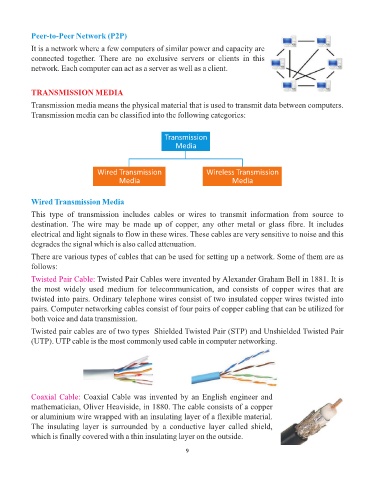
Peer-to-Peer Network (P2P)

            It is a network where a few computers of similar power and capacity are
            connected  together.  There  are  no  exclusive  servers  or  clients  in  this
            network. Each computer can act as a server as well as a client.


            TRANSMISSION MEDIA

            Transmission media means the physical material that is used to transmit data between computers.
            Transmission media can be classified into the following categories:


                                                          Transmission
                                                              Media


                                   Wired Transmission                   Wireless Transmission
                                          Media                                  Media


            Wired Transmission Media

            This  type  of  transmission  includes  cables  or  wires  to  transmit  information  from  source  to
            destination. The wire may be made up of copper, any other metal or glass fibre. It includes
            electrical and light signals to flow in these wires. These cables are very sensitive to noise and this
            degrades the signal which is also called attenuation.

            There are various types of cables that can be used for setting up a network. Some of them are as
            follows:

            Twisted Pair Cable: Twisted Pair Cables were invented by Alexander Graham Bell in 1881. It is
            the  most  widely  used  medium  for  telecommunication,  and  consists  of  copper  wires  that  are
            twisted into pairs. Ordinary telephone wires consist of two insulated copper wires twisted into
            pairs. Computer networking cables consist of four pairs of copper cabling that can be utilized for
            both voice and data transmission.

            Twisted pair cables are of two types  Shielded Twisted Pair (STP) and Unshielded Twisted Pair
            (UTP). UTP cable is the most commonly used cable in computer networking.


            Coaxial Cable: Coaxial Cable was invented by an English engineer and
            mathematician, Oliver Heaviside, in 1880. The cable consists of a copper
            or aluminium wire wrapped with an insulating layer of a flexible material.
            The  insulating  layer  is  surrounded  by  a  conductive  layer  called  shield,

            which is finally covered with a thin insulating layer on the outside.

                                                                 9

