


Page 115 - Innovator's Science-8
P. 115
solute, and the substance that dissolves the solute (usually water) is called
                                     the solvent . The solute spreads evenly throughout the solvent, forming a

                                     mixture  that  looks  the  same  everywhere.  For  example,  when  sugar
                                     dissolves in water, the sugar is the solute, and the water is the solvent,
                                     together  making  a  solution  where  you  can't  see  the  sugar  particles
                                     separately.

                                     Solute + Solvent         Solution

                                     When a solution is formed by mixing two liquids, it is not always clear which
                                     substance is dissolving the other. In such cases, the substance present in
                                     smaller amount is called the solute, while the one in larger amount is called
                                     the solvent.

                                     Just as water can act as a solvent in liquid solutions, gases can also form
                                     solution— with air being a common example. Air is a gaseous solution.

                                     Since nitrogen is present in the largest amount in the air, it is considered as
                                     the  solvent,  while  oxygen,  argon,  carbon  dioxide,  and  other  gases  are
                                     considered as solutes.

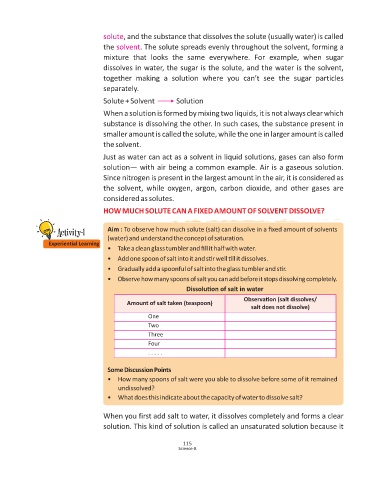
                                     HOW MUCH SOLUTE CAN A FIXED AMOUNT OF SOLVENT DISSOLVE?


                     Activity-1       Aim : To observe how much solute (salt) can dissolve in a fixed amount of solvents
                                      (water) and understand the concept of satura on.
                  Experiential Learning
                                      •  Take a clean glass tumbler and fill it half with water.
                                      •  Add one spoon of salt into it and s r well  ll it dissolves.
                                      •  Gradually add a spoonful of salt into the glass tumbler and s r.

                                      •  Observe how many spoons of salt you can add before it stops dissolving completely.
                                                                 Dissolu on of salt in water
                                                                                     Observa on (salt dissolves/
                                             Amount of salt taken (teaspoon)
                                                                                        salt does not dissolve)
                                                    One
                                                    Two
                                                    Three
                                                    Four
                                                    . . . . .


                                      Some Discussion Points
                                      •  How many spoons of salt were you able to dissolve before some of it remained
                                          undissolved?
                                      •  What does this indicate about the capacity of water to dissolve salt?


                                     When you first add salt to water, it dissolves completely and forms a clear
                                     solution. This kind of solution is called an unsaturated solution because it


                                                                115
                                                               Science-8

