


Page 116 - Innovator's Science-8
P. 116
can still dissolve more salt. But after adding some spoons of salt, there
                                     comes a point when salt stops dissolving and the extra salt settles at the

                                     bottom. This means the water has reached its limit for dissolving salt and is
                                     now called a saturated solution   at that temperature. In a saturated solution,
                                     no  more  solute  can  dissolve  unless  the  temperature  changes.  So,  an

               Unsaturated solution  unsaturated solution can dissolve more solute, while a saturated solution
                                     cannot dissolve anymore and has leftover undissolved solute.
                                     Concentration is the amount of solute (the substance dissolved) present in

                                     a fixed quantity of a solution or solvent. Depending on how much solute is
                                     dissolved, a solution can be called dilute if it has less solute, or concentrated
                             Solution
                                     if it has more solute. These terms are relative, meaning what is considered
                                     dilute or concentrated depends on the amount of solute compared to the
                           Undissolved
                              salt
                                     solvent. For example, if a little sugar is dissolved in water, it forms a dilute
              Saturated solution
                                     solution, but if a lot of sugar is dissolved, the solution is concentrated.
                 Science             Concentration helps us understand how strong or weak a solution is based
                     Bytes
                                     on the amount of solute it contains.

                           Testimony  So, one can say that, the solution obtained by dissolving one spoon of salt is
              The Dead Sea has one of
                 the highest salt    dilute as compared to that obtained by dissolving two or more spoons of
              concentra ons on Earth.   salt. Can you now reflect — which solution is more concentrated; 2 spoons
              its water is so dense that
             people can easily float on   of salt in 100 mL of water or 4 spoons of salt in 50 mL of water? We can say
                it without sinking.  that the maximum amount of solute that dissolves in a fixed quantity of the
                                     solvent is called its solubility .

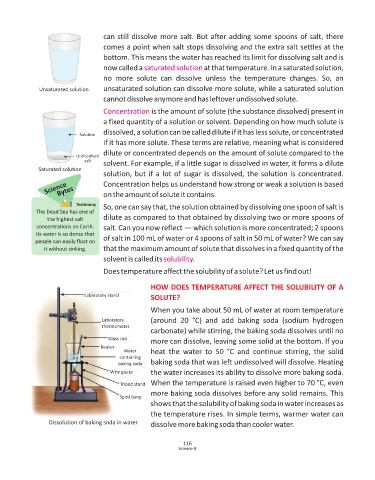
                                     Does temperature affect the solubility of a solute? Let us find out!

                                                     HOW DOES TEMPERATURE AFFECT THE SOLUBILITY OF A
                              Laboratory stand
                                                     SOLUTE?
                                                     When you take about 50 mL of water at room temperature
                                    Laboratory       (around  20  °C)  and  add  baking  soda  (sodium  hydrogen
                                    thermometer
                                                     carbonate) while stirring, the baking soda dissolves until no
                                      Glass rod
                                                     more can dissolve, leaving some solid at the bottom. If you
                                    Beaker
                                            Water    heat  the  water  to  50  °C  and  continue  stirring,  the  solid
                                          containing
                                          baking soda  baking soda that was left undissolved will dissolve. Heating

                                       Wire gauze    the water increases its ability to dissolve more baking soda.
                                           Tripod stand  When the temperature is raised even higher to 70 °C, even
                                                     more baking soda dissolves before any solid remains. This
                                          Spirit lamp
                                                     shows that the solubility of baking soda in water increases as
                                                     the temperature rises. In simple terms, warmer water can
                  Dissolution of baking soda in water  dissolve more baking soda than cooler water.


                                                                116
                                                               Science-8

