


Page 121 - Innovator's Science-8
P. 121
surface  of  the  liquid  called  the  meniscus.  This  way,  you  can  measure
                                     volumes of liquids precisely just like you learned to measure temperature

                                     accurately with a thermometer.
                                     The smallest volume that a measuring cylinder can measure depends on
                                     the  capacity  of  the  measuring  cylinder.  Usually  it  is  0.1  mL  in  smaller

                                     measuring cylinders with a capacity of 10 mL or 25 mL, it is 1 mL in a 100 mL
                 Science             measuring cylinder, 2 mL in a 250 mL measuring cylinder, and 5 mL in a 500
                     Bytes
                                     mL measuring cylinder. Suppose we want to take 70 mL of water. If we use a

                           Testimony  50 mL measuring cylinder, it would not be possible to measure 70 mL of
                The meniscus is the   water in one step. First, we have to measure 50 mL water and then 20 mL.
             curved surface of a liquid
              in a container. It forms   Measuring volume in more than one step is not convenient. On the other
             because of the a rac on   hand, if a 250 mL or 500 mL measuring cylinder is used, the measurement
              between the liquid and
               the container's walls.  can be done in one step but the accuracy would be reduced as the smallest
               • For clean liquids like   volume that these measuring cylinders can measure is greater than that of
             water, read the bo om of   a 100 mL measuring cylinder. Hence, a 100 mL measuring cylinder is the
                  the menicus.
             • For coloured or opaque   best choice for this measurement.
              liquids, read the top of
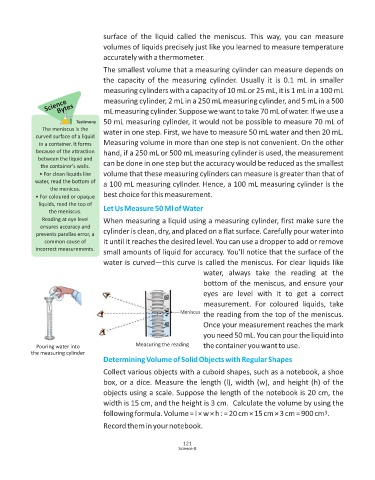
                  the meniscus.      Let Us Measure 50 Ml of Water
                Reading at eye level   When measuring a liquid using a measuring cylinder, first make sure the
               ensures accuracy and
             prevents parallax error, a   cylinder is clean, dry, and placed on a flat surface. Carefully pour water into
                common cause of      it until it reaches the desired level. You can use a dropper to add or remove
             incorrect measurements.
                                     small amounts of liquid for accuracy. You'll notice that the surface of the
                                     water is curved—this curve is called the meniscus. For clear liquids like
                                                                       water,  always  take  the  reading  at  the
                                                                       bottom of the meniscus, and ensure your
                                                                       eyes  are  level  with  it  to  get  a  correct

                                                                       measurement.  For  coloured  liquids,  take
                                                               Meniscus
                                                                       the reading from the top of the meniscus.
                                                                       Once your measurement reaches the mark

                                                                       you need 50 mL. You can pour the liquid into
              Pouring water into                Measuring the reading   the container you want to use.
            the measuring cylinder
                                     Determining Volume of Solid Objects with Regular Shapes
                                     Collect various objects with a cuboid shapes, such as a notebook, a shoe

                                     box, or a dice. Measure the length (l), width (w), and height (h) of the
                                     objects using a scale. Suppose the length of the notebook is 20 cm, the
                                     width is 15 cm, and the height is 3 cm.  Calculate the volume by using the
                                     following formula. Volume = l × w × h : = 20 cm × 15 cm × 3 cm = 900 cm .
                                                                                                                 3
                                     Record them in your notebook.


                                                                121
                                                               Science-8

