


Page 125 - Innovator's Science-8
P. 125
2.   Fill in the blanks:
                   i.  The  volume  of  a  solid  can  be  measured  by  the  method  of  displacement,  where  the  solid  is
                      ____________ in water and the ____________ in water level is measured.
                   ii.  The maximum amount of ____________ dissolved in ____________ at a par cular temperature is
                      called solubility at that temperature.
                   iii. Generally, the density ____________ with increase in temperature.
                   iv. The solu on in which glucose has completely dissolved in water, and no more glucose can dissolve at
                      a given temperature, is called a ____________ solu on of glucose.
              Ans.  i. placed; rise, ii. solute, solvent, iii. decrease, iv. saturated

              3.   You pour oil into a glass containing some water. The oil floats on top. What does this tell you?
                   i.  Oil is denser than water.
                   ii.  Water is denser than oil.
                   iii. Oil and water have the same density.
                   iv. Oil dissolves in water.
              Ans.  ii. Water is denser than oil.

              4.   A stone sculpture weighs 225 g and has a volume of 90 cm³. Calculate its density and predict whether it
                   will float or sink in water.
              Ans.  Density of stone = 225/90 = 2.5 g/cm³
                   It will sink in water.

              5.   Which one of the following is the most appropriate statement, and why are the other statements not
                   appropriate?
                   i.  A saturated solu on can s ll dissolve more solute at a given temperature.
                   ii.  An  unsaturated  solu on  has  dissolved  the  maximum  amount  of  solute  possible  at  a  given
                      temperature.
                   iii. No more solute can be dissolved into the saturated solu on at that temperature.
                   iv. A saturated solu on forms only at high temperatures.
              Ans.  Statement, iii. is most appropriate.

              6.   You have a bo le with a volume of 2 litres. You pour 500 mL of water into it. How much more water can
                   the bo le hold?

              Ans.  2 litres = 2 × 1000 = 2000 mL
                   Total volume – Poured volume
                   2000 – 500 = 1500 mL
                   The bo le of 2 litres capacity can hold 1500 mL more of water besides 500 mL.

              7.   An object has a mass of 400 g and a volume of 40 cm³. What is its density?
              Ans.  Density = mass/volume
                   = 400/40
                   = 10 g/cm³
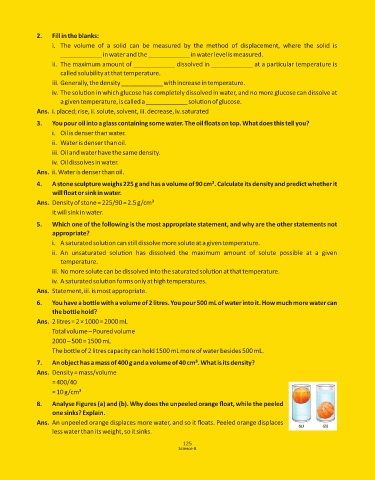
              8.   Analyse Figures (a) and (b). Why does the unpeeled orange float, while the peeled
                   one sinks? Explain.
              Ans.  An unpeeled orange displaces more water, and so it floats. Peeled orange displaces
                   less water than its weight, so it sinks.

                                                                125
                                                               Science-8

