


Page 122 - Innovator's Science-8
P. 122
Determining Volume of Objects with Irregular Shapes

                                     To find the volume of an object that has an irregular shape, like a stone, we
                                     can use the water displacement method          . First, fill a measuring cylinder
                                     with water and record the starting water level. Then gently put the stone
                                     into the cylinder, making sure it is completely underwater. The water level

                                     will rise because the stone pushes some water out of the way—this rise
                 Science             indicates the volume of the water displaced, which equals the volume of
                     Bytes
                                     the stone. To figure out the stone's volume, subtract the starting level of

                           Testimony  the water from the final level after the stone is in. The difference is the
              The water displacement   volume of the object, measured in milliliters (which is the same as cubic
               method works on the
              principle discovered by   centimeters). This method works well for any small solid that doesn't have
               Archimedes. When an   a regular shape. You can understand it through an activity.
               irregular solid is fully
               immersed in water, it   Collect various objects from your surroundings, such as a stone, metal keys,
             pushes out (displaces) an   and so on.
             amount of water equal to
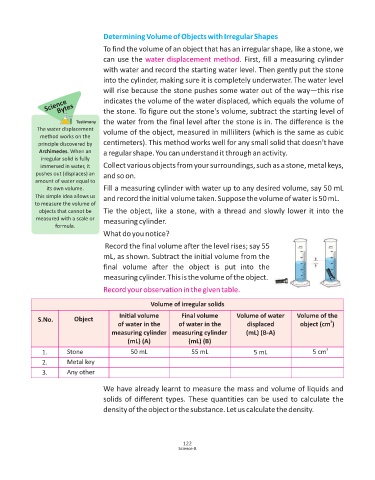
                 its own volume.     Fill a measuring cylinder with water up to any desired volume, say 50 mL
             This simple idea allows us   and record the initial volume taken. Suppose the volume of water is 50 mL.
             to measure the volume of
              objects that cannot be   Tie the object, like a stone, with a thread and slowly lower it into the
             measured with a scale or   measuring cylinder.
                    formula.
                                     What do you notice?
                                      Record the final volume after the level rises; say 55
                                     mL, as shown. Subtract the initial volume from the

                                     final  volume  after  the  object  is  put  into  the
                                     measuring cylinder. This is the volume of the object.

                                     Record your observation in the given table.

                                                     Volume of irregular solids
                                          Ini al volume         Final volume       Volume of water      Volume of the
              S.No.        Object                                                                                  3
                                          of water in the      of water in the        displaced          object (cm )
                                        measuring cylinder  measuring cylinder        (mL) (B-A)
                                             (mL) (A)             (mL) (B)
                1.      Stone                 50 mL                55 mL                 5 mL                5 cm 3

                2.      Metal key
                3.      Any other

                                     We have already learnt to measure the mass and volume of liquids and
                                     solids of different types. These quantities can be used to calculate the

                                     density of the object or the substance. Let us calculate the density.


                                                                122
                                                               Science-8

