


Page 126 - Innovator's Science-8
P. 126
9.   Object A has a mass of 200 g and a volume of 40 cm³. Object B has a mass of 240 g and a volume of 60
                   cm³. Which object is denser?
              Ans.  Density of object A = 200/40 = 5 g/cm³
                   Density of object B = 240/60 = 4 g/cm³
                   Conclusion: Object A is denser, having more density than B.

              10.  Reema has a piece of modeling clay that weighs 120 g. She first moulds it into a compact cube that has
                   a volume of 60 cm³. Later, she fla ens it into a thin sheet. Predict what will happen to its density.
              Ans.  The density of fla ened clay will decrease as it displaces more liquid.
              11.  A block of iron has a mass of 600 g and a density of 7.9 g/cm³. What is its volume?
              Ans.  We know density = mass/volume

                   ∴ Volume = mass/density
                   = 600 g/7.9 g/cm3
                   = 75.94 cm³

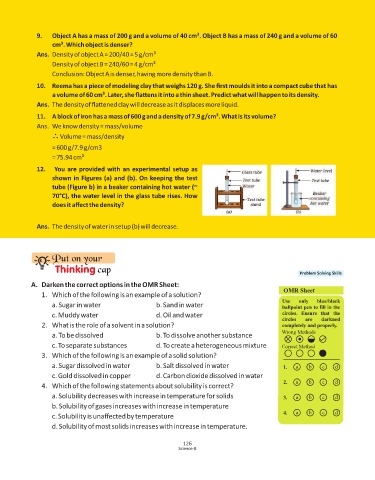
              12.   You are provided with an experimental setup as
                   shown in Figures (a) and (b). On keeping the test
                   tube (Figure b) in a beaker containing hot water (~
                   70°C), the water level in the glass tube rises. How
                   does it affect the density?


              Ans.  The density of water in setup (b) will decrease.


                   Put on your
                    Thinking cap                                                                         Problem Solving Skills


            A.  Darken the correct options in the OMR Sheet:
                                                                                                   OMR Sheet
               1.  Which of the following is an example of a solution?
                   a. Sugar in water                   b. Sand in water
                   c. Muddy water                      d. Oil and water
               2.  What is the role of a solvent in a solution?
                                                                                                  Wrong Methods
                   a. To be dissolved                  b. To dissolve another substance
                   c. To separate substances           d. To create a heterogeneous mixture       Correct Method
               3.  Which of the following is an example of a solid solution?
                   a. Sugar dissolved in water         b. Salt dissolved in water                  1.  a    b   c    d
                   c. Gold dissolved in copper         d. Carbon dioxide dissolved in water
                                                                                                   2.  a    b   c    d
               4.  Which of the following statements about solubility is correct?
                   a. Solubility decreases with increase in temperature for solids                 3.  a    b   c    d
                   b. Solubility of gases increases with increase in temperature
                   c. Solubility is unaffected by temperature                                      4.  a    b   c    d
                   d. Solubility of most solids increases with increase in temperature.


                                                                126
                                                               Science-8

