


Page 129 - Innovator's Science-8
P. 129
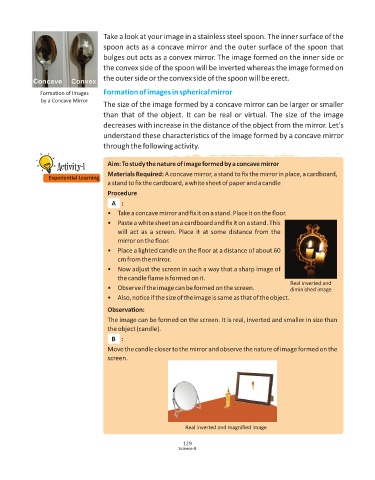
Take a look at your image in a stainless steel spoon. The inner surface of the
                                     spoon acts as a concave mirror and the outer surface of the spoon that

                                     bulges out acts as a convex mirror. The image formed on the inner side or
                                     the convex side of the spoon will be inverted whereas the image formed on
                                     the outer side or the convex side of the spoon will be erect.


               Formation of Images   Formation of images in spherical mirror
               by a Concave Mirror
                                     The size of the image formed by a concave mirror can be larger or smaller
                                     than that of the object. It can be real or virtual. The size of the image
                                     decreases with increase in the distance of the object from the mirror. Let's
                                     understand these characteristics of the image formed by a concave mirror

                                     through the following activity.


                     Activity-1       Aim: To study the nature of image formed by a concave mirror
                                      Materials Required: A concave mirror, a stand to fix the mirror in place, a cardboard,
                  Experiential Learning
                                      a stand to fix the cardboard, a white sheet of paper and a candle
                                      Procedure
                                         A    :
                                      •  Take a concave mirror and fix it on a stand. Place it on the floor.
                                      •  Paste a white sheet on a cardboard and fix it on a stand. This
                                          will act as a screen. Place it at some distance from the
                                          mirror on the floor.
                                      •  Place a lighted candle on the floor at a distance of about 60
                                          cm from the mirror.
                                      •  Now adjust the screen in such a way that a sharp image of
                                          the candle flame is formed on it.
                                                                                                     Real inverted and
                                      •  Observe if the image can be formed on the screen.           diminished image

                                      •  Also, no ce if the size of the image is same as that of the object.
                                      Observa on:
                                      The image can be formed on the screen. It is real, inverted and smaller in size than
                                      the object (candle).
                                         B    :

                                      Move the candle closer to the mirror and observe the nature of image formed on the
                                      screen.


                                                                 Real inverted and magnified image

                                                                129
                                                               Science-8

