


Page 132 - Innovator's Science-8
P. 132
Laws of Reflection

                                     Look at the figure given previously again. You
                                     will see the image of object A as A' and object
                                     B  as  B'.  Also  i  =  r  and  i  =  r,  i.e.,  angle  of
                                     incidence  is  always  equal  to  the  angle  of

                                     reflection. Also the incident ray, the reflected
                                     ray and the normal all lie in the same plane.
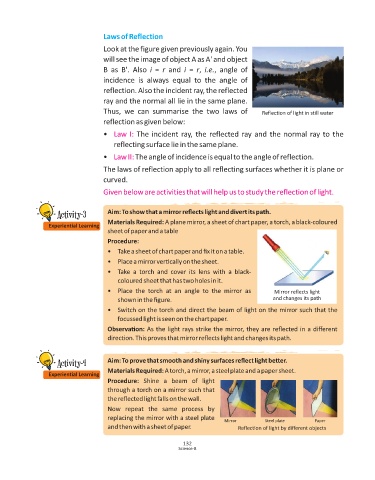
                                     Thus,  we  can  summarise  the  two  laws  of          Reflection of light in still water

                                     reflection as given below:
                                     •  Law I:  The incident ray, the reflected ray and the normal ray to the
                                        reflecting surface lie in the same plane.

                                     •  Law II:  The angle of incidence is equal to the angle of reflection.

                                     The laws of reflection apply to all reflecting surfaces whether it is plane or
                                     curved.

                                     Given below are activities that will help us to study the reflection of light.


                     Activity-3       Aim: To show that a mirror reflects light and divert its path.
                                      Materials Required: A plane mirror, a sheet of chart paper, a torch, a black-coloured
                  Experiential Learning
                                      sheet of paper and a table
                                      Procedure:

                                      •  Take a sheet of chart paper and fix it on a table.
                                      •  Place a mirror ver cally on the sheet.
                                      •  Take  a  torch  and  cover  its  lens  with  a  black-
                                          coloured sheet that has two holes in it.
                                      •  Place  the  torch  at  an  angle  to  the  mirror  as   Mirror reflects light
                                          shown in the figure.                                  and changes its path
                                      •  Switch on the torch and direct the beam of light on the mirror such that the
                                          focussed light is seen on the chart paper.
                                      Observa on: As the light rays strike the mirror, they are reflected in a different
                                      direc on. This proves that mirror reflects light and changes its path.


                     Activity-4       Aim: To prove that smooth and shiny surfaces reflect light be er.
                                      Materials Required: A torch, a mirror, a steel plate and a paper sheet.
                  Experiential Learning
                                      Procedure:  Shine  a  beam  of  light
                                      through a torch on a mirror such that
                                      the reflected light falls on the wall.

                                      Now  repeat  the  same  process  by
                                      replacing the mirror with a steel plate
                                                                               Mirror        Steel plate      Paper
                                      and then with a sheet of paper.              Reflec on of light by different objects


                                                                132
                                                               Science-8

