


Page 128 - Innovator's Science-8
P. 128
10              Light : Mirrors and Lenses


                                       Intended Learning Outcomes

                                          Sphenical Mirrors                          Reflec on on Light
                                          Laws of Reflec on                           Lenses


                                       Stepping Stones

                                       1.  Have you ever no ced how your face looks larger in a shaving mirror but
                                           smaller in a car's side mirror?
                                       2.   Why  does  a  spoon  some mes  show  your  reflec on  upside  down  and
                                           some mes straight?
                                       3.   Why  does  a  magnifying  glass  make  objects  appear  bigger  when  you  look
                                           through it?


                                     During the summer holidays, a science museum hosted an exhibition filled
                                     with fascinating displays on nature, space, and technology. One section
                                     showcased a range of mirrors and lenses that instantly drew everyone's
                                     attention.  When  visitors  looked  into  them,  their  reflections  appeared

                                     completely different from what they usually saw in an ordinary mirror.
                                     Some faces looked unusually large, others appeared tiny, and a few even
                                     seemed to be upside down!

                                     Curious  students  gathered  around,  trying  to  figure  out  why  the  same
                                     person could look so different in each mirror. The guide explained that not
                                     all mirrors are flat - some have curved surfaces that bend light differently.

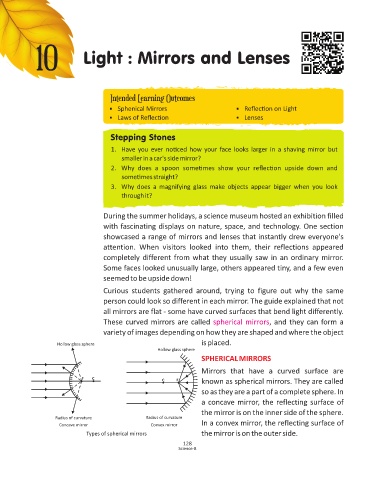
                                     These curved mirrors are called spherical mirrors        , and they can form a
                                     variety of images depending on how they are shaped and where the object

                     Hollow glass sphere                               is placed.
                                                       Hollow glass sphere
                                                                       SPHERICAL MIRRORS

                                                                       Mirrors  that  have  a  curved  surface  are
                             F   C
                                                         C    F        known as spherical mirrors. They are called
                                                                       so as they are a part of a complete sphere. In
                                                                       a concave mirror, the reflecting surface of
                                                                       the mirror is on the inner side of the sphere.
                    Radius of curvature            Radius of curvature
                     Concave mirror                  Convex mirror     In a convex mirror, the reflecting surface of
                               Types of spherical mirrors              the mirror is on the outer side.
                                                                128
                                                               Science-8

