


Page 123 - Innovator's Science-8
P. 123
Density can be calculated using the following formula:
                                                     Mass
                                        Density=
                                                    Volume
                                        16.400/5= 3.28 g/cm     3

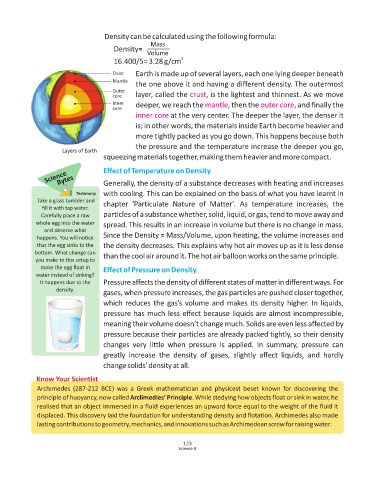
                                        Crust   Earth is made up of several layers, each one lying deeper beneath
                                        Mantle
                                                the one above it and having a different density. The outermost
                                        Outer
                                        core    layer, called the crust , is the lightest and thinnest. As we move
                                        Inner   deeper, we reach the mantle     , then the outer core  , and finally the
                                        core
                                                inner core at the very center. The deeper the layer, the denser it
                                                is; in other words, the materials inside Earth become heavier and

                                                more tightly packed as you go down. This happens because both
                                                the pressure and the temperature increase the deeper you go,
                       Layers of Earth
                                     squeezing materials together, making them heavier and more compact.

                 Science             Effect of Temperature on Density
                     Bytes
                                     Generally, the density of a substance decreases with heating and increases
                           Testimony  with cooling. This can be explained on the basis of what you have learnt in
              Take a glass tumbler and   chapter  'Particulate  Nature  of  Matter'.  As  temperature  increases,  the
               fill it with tap water.
               Carefully place a raw   particles of a substance whether, solid, liquid, or gas, tend to move away and
             whole egg into the water   spread. This results in an increase in volume but there is no change in mass.
                and observe what
              happens. You will no ce   Since the Density = Mass/Volume, upon heating, the volume increases and
              that the egg sinks to the   the density decreases. This explains why hot air moves up as it is less dense
             bo om. What change can   than the cool air around it. The hot air balloon works on the same principle.
             you make to this setup to
               make the egg float in   Effect of Pressure on Density
             water instead of sinking?
               It happens due to the   Pressure affects the density of different states of matter in different ways. For
                    density.
                                     gases, when pressure increases, the gas particles are pushed closer together,
                                     which reduces the gas’s volume and makes its density higher. In liquids,
                                     pressure has much less effect because liquids are almost incompressible,
                                     meaning their volume doesn’t change much. Solids are even less affected by
                                     pressure because their particles are already packed tightly, so their density

                                     changes  very  little  when  pressure  is  applied.  In  summary,  pressure  can
                                     greatly  increase  the  density  of  gases,  slightly  affect  liquids,  and  hardly
                                     change solids' density at all.

              Know Your Scientist
              Archimedes  (287-212  BCE)  was  a  Greek  mathematician  and  physicest  beset  known  for  discovering  the
              principle of huoyancy, now called Arclimedies’ Principle. While stedying how objects float or sink in water, he
              realised that an object immersed in a fluid experiences an upward force equal to the weight of the fluid it
              displaced. This discovery laid the foundation for understanding density and flotation. Archimedes also made
              lasting contributions to geometry, mechanics, and innovations such as Archimedean screw for raising water.


                                                                123
                                                               Science-8

