


Page 120 - Innovator's Science-8
P. 120
mass  stays  constant.  Most  common
                                     balances  measure  weight  but  show  the

                                     reading  as  mass  because  on  Earth,  the                                 Hook
                                     gravity  is  almost  constant.  So,  when  you
                                     weigh something, you usually see its mass,                Pan          Pan
                                     but technically, you're measuring the force
                                                                                                         Pointer
                                     of gravity on it.
                                                                                                Two-pan balance
                                     How to Measure Volume?
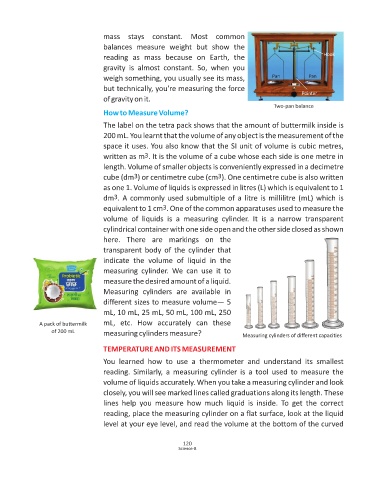
                                     The label on the tetra pack shows that the amount of buttermilk inside is
                                     200 mL. You learnt that the volume of any object is the measurement of the

                                     space it uses. You also know that the SI unit of volume is cubic metres,
                                                   3
                                     written as m . It is the volume of a cube whose each side is one metre in
                                     length. Volume of smaller objects is conveniently expressed in a decimetre
                                                                            3
                                               3
                                     cube (dm ) or centimetre cube (cm ). One centimetre cube is also written
                                     as one 1. Volume of liquids is expressed in litres (L) which is equivalent to 1
                                        3
                                     dm . A commonly used submultiple of a litre is millilitre (mL) which is
                                                         3
                                     equivalent to 1 cm . One of the common apparatuses used to measure the
                                     volume  of  liquids  is  a  measuring  cylinder.  It  is  a  narrow  transparent

                                     cylindrical container with one side open and the other side closed as shown
                                     here.  There  are  markings  on  the
                                     transparent  body  of  the  cylinder  that
                                     indicate  the  volume  of  liquid  in  the

                                     measuring  cylinder.  We  can  use  it  to
                                     measure the desired amount of a liquid.
                                     Measuring  cylinders  are  available  in
                                     different sizes to measure volume— 5

                                     mL, 10 mL, 25 mL, 50 mL, 100 mL, 250
               A pack of buttermilk   mL,  etc.  How  accurately  can  these
                   of 200 mL         measuring cylinders measure?                    Measuring cylinders of different capacities

                                     TEMPERATURE AND ITS MEASUREMENT

                                     You  learned  how  to  use  a  thermometer  and  understand  its  smallest
                                     reading.  Similarly,  a  measuring  cylinder  is  a  tool  used  to  measure  the

                                     volume of liquids accurately. When you take a measuring cylinder and look
                                     closely, you will see marked lines called graduations along its length. These
                                     lines  help  you  measure  how  much  liquid  is  inside.  To  get  the  correct
                                     reading, place the measuring cylinder on a flat surface, look at the liquid

                                     level at your eye level, and read the volume at the bottom of the curved


                                                                120
                                                               Science-8

