


Page 138 - Innovator's Science-8
P. 138
Ans.     Image                    Mirror
                      Image i.      Convex mirror
                      Image ii.     Concave mirror
                      Image iii.    Plane mirror

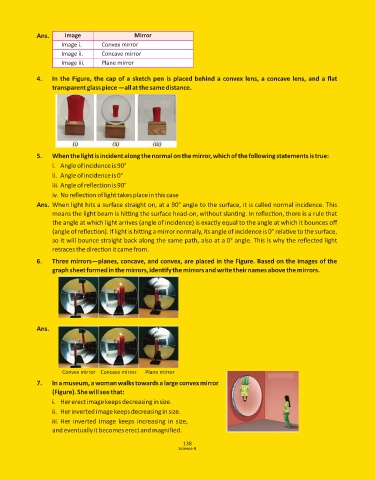
              4.   In the Figure, the cap of a sketch pen is placed behind a convex lens, a concave lens, and a flat
                   transparent glass piece —all at the same distance.


              5.   When the light is incident along the normal on the mirror, which of the following statements is true:
                   i.  Angle of incidence is 90°
                   ii.  Angle of incidence is 0°
                   iii. Angle of reflec on is 90°
                   iv. No reflec on of light takes place in this case

              Ans.  When light hits a surface straight on, at a 90° angle to the surface, it is called normal incidence. This
                   means the light beam is hi ng the surface head-on, without slan ng. In reflec on, there is a rule that
                   the angle at which light arrives (angle of incidence) is exactly equal to the angle at which it bounces off
                   (angle of reflec on). If light is hi ng a mirror normally, its angle of incidence is 0° rela ve to the surface,
                   so it will bounce straight back along the same path, also at a 0° angle. This is why the reflected light
                   retraces the direc on it came from.

              6.   Three mirrors—planes, concave, and convex, are placed in the Figure. Based on the images of the
                   graph sheet formed in the mirrors, iden fy the mirrors and write their names above the mirrors.


              Ans.


                       Convex mirror  Concave mirror   Plane mirror
              7.   In a museum, a woman walks towards a large convex mirror
                   (Figure). She will see that:
                   i.  Her erect image keeps decreasing in size.
                   ii.  Her inverted image keeps decreasing in size.
                   iii. Her inverted image keeps increasing in size,
                   and eventually it becomes erect and magnified.

                                                                138
                                                               Science-8

