


Page 140 - Innovator's Science-8
P. 140
ii.  Figure (a) indicates a convex mirror and Figure (b) indicates a concave mirror.
                   iii. Figure (a) indicates a concave mirror and Figure (b) indicates a convex mirror.
                   iv. Figure (a) indicates a plane mirror, and Figure (b) indicates a convex mirror.
              Ans.  (ii) Figure (a) indicates a convex mirror and Figure (b) indicates a concave mirror.

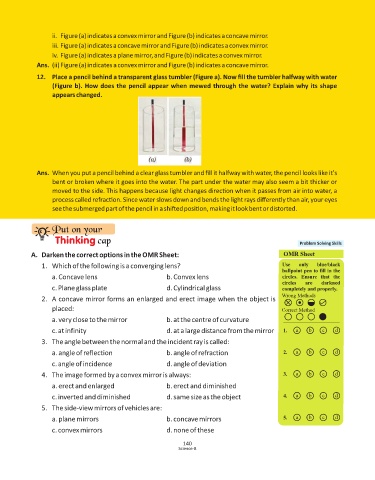
              12.  Place a pencil behind a transparent glass tumbler (Figure a). Now fill the tumbler halfway with water
                   (Figure b). How does the pencil appear when mewed through the water? Explain why its shape
                   appears changed.


              Ans.  When you put a pencil behind a clear glass tumbler and fill it halfway with water, the pencil looks like it's
                   bent or broken where it goes into the water. The part under the water may also seem a bit thicker or
                   moved to the side. This happens because light changes direc on when it passes from air into water, a
                   process called refrac on. Since water slows down and bends the light rays differently than air, your eyes
                   see the submerged part of the pencil in a shi ed posi on, making it look bent or distorted.


                   Put on your
                    Thinking cap                                                                         Problem Solving Skills

            A.  Darken the correct options in the OMR Sheet:                                       OMR Sheet

               1.  Which of the following is a converging lens?
                   a. Concave lens                         b. Convex lens
                   c. Plane glass plate                    d. Cylindrical glass
                                                                                                  Wrong Methods
               2.  A concave mirror forms an enlarged and erect image when the object is
                   placed:                                                                        Correct Method
                   a. very close to the mirror             b. at the centre of curvature

                   c. at infinity                          d. at a large distance from the mirror  1.  a    b   c    d
               3.  The angle between the normal and the incident ray is called:
                   a. angle of reflection                  b. angle of refraction                  2.  a    b   c    d

                   c. angle of incidence                   d. angle of deviation
               4.  The image formed by a convex mirror is always:                                  3.  a    b   c    d
                   a. erect and enlarged                   b. erect and diminished

                   c. inverted and diminished              d. same size as the object              4.  a    b   c    d
               5.  The side-view mirrors of vehicles are:

                   a. plane mirrors                        b. concave mirrors                      5.  a    b   c    d
                   c. convex mirrors                       d. none of these

                                                                140
                                                               Science-8

