


Page 144 - Innovator's Science-8
P. 144
PHASES OF THE MOON

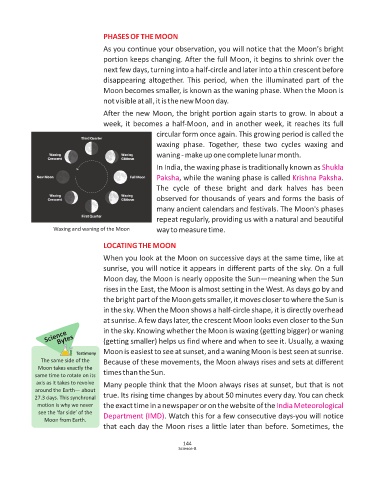
                                     As you continue your observation, you will notice that the Moon's bright
                                     portion keeps changing. After the full Moon, it begins to shrink over the
                                     next few days, turning into a half-circle and later into a thin crescent before
                                     disappearing  altogether.  This  period,  when  the  illuminated  part  of  the

                                     Moon becomes smaller, is known as the waning phase. When the Moon is
                                     not visible at all, it is the new Moon day.

                                     After the new Moon, the bright portion again starts to grow. In about a
                                     week, it becomes a half-Moon, and in another week, it reaches its full
                                                       circular form once again. This growing period is called the
                                                       waxing  phase.  Together,  these  two  cycles  waxing  and

                                                       waning - make up one complete lunar month.
                                                       In India, the waxing phase is traditionally known as Shukla

                                                       Paksha, while the waning phase is called       Krishna Paksha.
                                                       The  cycle  of  these  bright  and  dark  halves  has  been
                                                       observed for thousands of years and forms the basis of
                                                       many ancient calendars and festivals. The Moon's phases
                                                       repeat regularly, providing us with a natural and beautiful

                   Waxing and waning of the Moon       way to measure time.

                                     LOCATING THE MOON

                                     When you look at the Moon on successive days at the same time, like at
                                     sunrise, you will notice it appears in different parts of the sky. On a full
                                     Moon day, the Moon is nearly opposite the Sun—meaning when the Sun

                                     rises in the East, the Moon is almost setting in the West. As days go by and
                                     the bright part of the Moon gets smaller, it moves closer to where the Sun is
                                     in the sky. When the Moon shows a half-circle shape, it is directly overhead
                                     at sunrise. A few days later, the crescent Moon looks even closer to the Sun

                 Science             in the sky. Knowing whether the Moon is waxing (getting bigger) or waning
                     Bytes
                                     (getting smaller) helps us find where and when to see it. Usually, a waxing
                                     Moon is easiest to see at sunset, and a waning Moon is best seen at sunrise.
                           Testimony
               The same side of the   Because of these movements, the Moon always rises and sets at different
              Moon takes exactly the
             same  me to rotate on its   times than the Sun.
              axis as it takes to revolve   Many people think that the Moon always rises at sunset, but that is not
             around the Earth— about
             27.3 days. This synchronal   true. Its rising time changes by about 50 minutes every day. You can check
              mo on is why we never   the exact time in a newspaper or on the website of the India Meteorological
              see the ‘far side’ of the   Department (IMD). Watch this for a few consecutive days-you will notice
                Moon from Earth.
                                     that each day the Moon rises a little later than before. Sometimes, the


                                                                144
                                                               Science-8

