


Page 146 - Innovator's Science-8
P. 146
When you hold the ball directly opposite the lamp, you can see its entire
                                     bright side - just like we see a full Moon in the night sky.

                                     When you turn and face the lamp, you can see only the dark side of the ball,
                                     similar to the new Moon day, when the Moon's bright side faces away from
                                     Earth.
                 Science             In  between  these  two  positions,  the  line  dividing  the  bright  and  dark
                     Bytes
                                     portions appears curved. This curved boundary looks just like the one we
                           Testimony
              The moon is rota ng at   see on the Moon during other days of the month.
               the same rate that it   You can now compare your observations from this activity with the actual
             revolves around Earth, so
               the same hemisphere   phases of the Moon shown below.
              faces Earth all the  me.
                                     UNDERSTANDING THE PHASES OF THE MOON

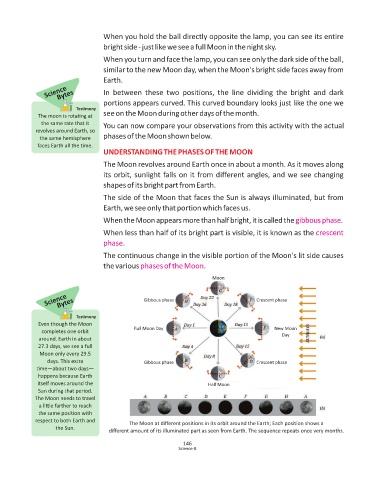
                                     The Moon revolves around Earth once in about a month. As it moves along
                                     its orbit, sunlight falls on it from different angles, and we see changing
                                     shapes of its bright part from Earth.

                                     The side of the Moon that faces the Sun is always illuminated, but from
                                     Earth, we see only that portion which faces us.

                                     When the Moon appears more than half bright, it is called the gibbous phase       .
                                     When less than half of its bright part is visible, it is known as the crescent

                                     phase.
                                     The continuous change in the visible portion of the Moon's lit side causes
                                     the various phases of the Moon    .

                                                                          Moon


                 Science                           Gibbous phase                          Crescent phase
                     Bytes


                           Testimony
              Even though the Moon
                                               Full Moon Day                                    New Moon
               completes one orbit
                                                                                                  Day
              around. Earth in about
              27.3 days, we see a full
               Moon only every 29.5
                 days. This extra                  Gibbous phase                          Crescent phase
               me—about two days—
              happens because Earth
              itself moves around the                                    Half Moon
              Sun during that period.
             The Moon needs to travel
              a li le farther to reach
              the same posi on with
             respect to both Earth and
                                              The Moon at different positions in its orbit around the Earth; Each position shows a
                    the Sun.
                                       different amount of its illuminated part as seen from Earth. The sequence repeats once very months.
                                                                146
                                                               Science-8

