


Page 151 - Innovator's Science-8
P. 151
become noticeable only after long intervals. Today, astronomers rely on the
                                     sidereal year to keep track of the Earth's position in its orbit around the Sun.

                                     For thousands of years, people – especially in India – have observed the sky
                                     carefully and developed their own calendars. Earth revolves around the
                                     Sun,  and  without  the  help  of  modern  tools,  their  keen  observations

                                     revealed repeating patterns in nature. From these patterns, they learned
                                     that a year lasts about 365 days, which helped them make calendars. For
                                     example, they observed that the Sun's position at sunrise shifts slightly

                                     from true East through the year. In summer, it rises a bit north of East, and in
                                     winter,  a  bit  south  of  East.  These  farthest  points  happen  during  the
                                     solstices, around June 21 and December 21 each year.

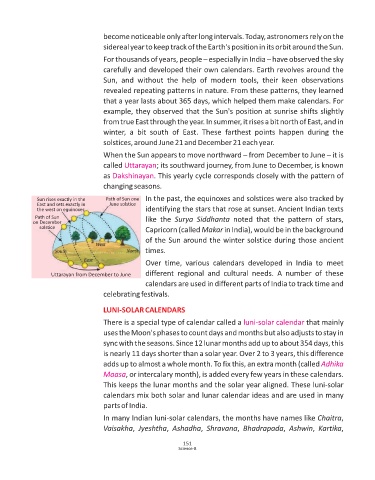
                                     When the Sun appears to move northward – from December to June – it is
                                     called Uttarayan  ; its southward journey, from June to December, is known
                                     as Dakshinayan   . This yearly cycle corresponds closely with the pattern of
                                     changing seasons.

              Sun rises exactly in the  Path of Sun one  In the past, the equinoxes and solstices were also tracked by
              East and sets exactly in  June solstice
              the west on equinoxes                identifying the stars that rose at sunset. Ancient Indian texts
             Path of Sun                           like  the  Surya  Siddhanta  noted  that  the  pattern  of  stars,
            on December
               solstice
                                                   Capricorn (called Makar in India), would be in the background
                                                   of the Sun around the winter solstice during those ancient
                                                   times.

                                                   Over  time,  various  calendars  developed  in  India  to  meet

                   Uttarayan from December to June  different  regional  and  cultural  needs.  A  number  of  these
                                                   calendars are used in different parts of India to track time and

                                     celebrating festivals.

                                     LUNI-SOLAR CALENDARS

                                     There is a special type of calendar called a luni-solar calendar      that mainly
                                     uses the Moon's phases to count days and months but also adjusts to stay in
                                     sync with the seasons. Since 12 lunar months add up to about 354 days, this

                                     is nearly 11 days shorter than a solar year. Over 2 to 3 years, this difference
                                     adds up to almost a whole month. To fix this, an extra month (called Adhika
                                     Maasa, or intercalary month), is added every few years in these calendars.
                                     This keeps the lunar months and the solar year aligned. These luni-solar
                                     calendars mix both solar and lunar calendar ideas and are used in many

                                     parts of India.
                                     In many Indian luni-solar calendars, the months have names like Chaitra,

                                     Vaisakha,  Jyeshtha,  Ashadha,  Shravana,  Bhadrapada,  Ashwin,  Kartika,

                                                                151
                                                               Science-8

