


Page 152 - Innovator's Science-8
P. 152
Margashirsha (or Agrahayan), Pausha, Magha, and Phalguna. In some
                                     places, the new month begins the day after the new Moon and ends on the

                                     next new Moon; these calendars are called Amant        . In other places, the new
                                     month starts the day after the full Moon and ends on the next full Moon;
                                     these are called Purnimant calendars     . Both ways help organize the months
                                     based on the Moon's phases.


                                     THE INDIAN NATIONAL CALENDAR
                                     The  Government  of  India  adopted  a  national  Calendar,  which  is  used

                                     alongside the Gregorian calendar for various official functions and records.


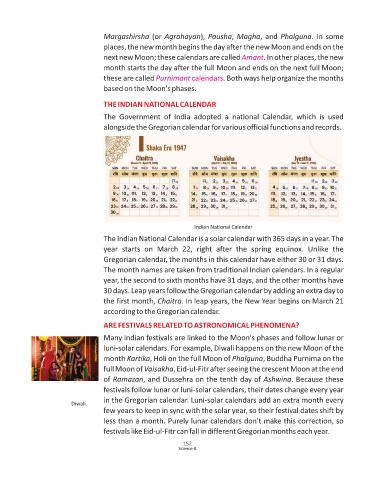
                                                                    Indian National Calendar

                                     The Indian National Calendar is a solar calendar with 365 days in a year. The
                                     year  starts  on  March  22,  right  after  the  spring  equinox.  Unlike  the
                                     Gregorian calendar, the months in this calendar have either 30 or 31 days.
                                     The month names are taken from traditional Indian calendars. In a regular

                                     year, the second to sixth months have 31 days, and the other months have
                                     30 days. Leap years follow the Gregorian calendar by adding an extra day to
                                     the first month, Chaitra. In leap years, the New Year begins on March 21
                                     according to the Gregorian calendar.

                                     ARE FESTIVALS RELATED TO ASTRONOMICAL PHENOMENA?

                                     Many Indian festivals are linked to the Moon's phases and follow lunar or
                                     luni-solar calendars. For example, Diwali happens on the new Moon of the
                                     month Kartika, Holi on the full Moon of Phalguna, Buddha Purnima on the

                                     full Moon of Vaisakha, Eid-ul-Fitr after seeing the crescent Moon at the end
                                     of Ramazan, and Dussehra on the tenth day of Ashwina. Because these
                                     festivals follow lunar or luni-solar calendars, their dates change every year

                                     in the Gregorian calendar. Luni-solar calendars add an extra month every
                          Diwali
                                     few years to keep in sync with the solar year, so their festival dates shift by
                                     less than a month. Purely lunar calendars don't make this correction, so
                                     festivals like Eid-ul-Fitr can fall in different Gregorian months each year.

                                                                152
                                                               Science-8

