


Page 157 - Innovator's Science-8
P. 157
Ans.            Picture label (e.g. A, B, C, etc.)          Phase of Moon
                                           C                     Three days after New Moon
                                           E                     Full Moon
                                           F                     Three days after Full Moon
                                           A                     A week after Full Moon
                                           B                     Day of New Moon

                   ii.  Picture B (New Moon phase) is never seen from Earth because the illuminated side of the Moon is
                      facing away from us.

              5.   Malini saw the Moon overhead in the sky at sunset.
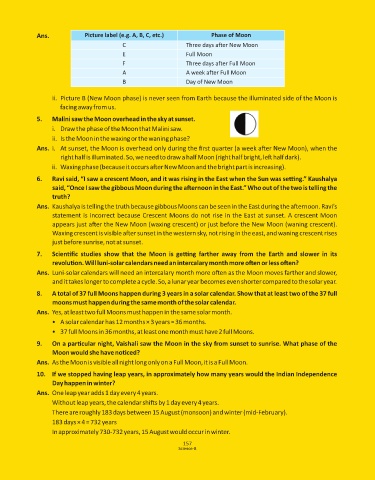
                   i.  Draw the phase of the Moon that Malini saw.
                   ii.  Is the Moon in the waxing or the waning phase?
              Ans.  i.  At sunset, the Moon is overhead only during the first quarter (a week a er New Moon), when the
                      right half is illuminated. So, we need to draw a half Moon (right half bright, le  half dark).
                   ii.  Waxing phase (because it occurs a er New Moon and the bright part is increasing).

              6.   Ravi said, “I saw a crescent Moon, and it was rising in the East when the Sun was se ng.” Kaushalya
                   said, “Once I saw the gibbous Moon during the a ernoon in the East.” Who out of the two is telling the
                   truth?
              Ans.  Kaushalya is telling the truth because gibbous Moons can be seen in the East during the a ernoon. Ravi’s
                   statement is incorrect because Crescent Moons do not rise in the East at sunset. A crescent Moon
                   appears just a er the New Moon (waxing crescent) or just before the New Moon (waning crescent).
                   Waxing crescent is visible a er sunset in the western sky, not rising in the east, and waning crescent rises
                   just before sunrise, not at sunset.
              7.   Scien fic  studies  show  that  the  Moon  is  ge ng  farther  away  from  the  Earth  and  slower  in  its
                   revolu on. Will luni-solar calendars need an intercalary month more o en or less o en?
              Ans.  Luni-solar calendars will need an intercalary month more o en as the Moon moves farther and slower,
                   and it takes longer to complete a cycle. So, a lunar year becomes even shorter compared to the solar year.

              8.   A total of 37 full Moons happen during 3 years in a solar calendar. Show that at least two of the 37 full
                   moons must happen during the same month of the solar calendar.

              Ans.  Yes, at least two full Moons must happen in the same solar month.
                   •  A solar calendar has 12 months × 3 years = 36 months.
                   •  37 full Moons in 36 months, at least one month must have 2 full Moons.
              9.   On a par cular night, Vaishali saw the Moon in the sky from sunset to sunrise. What phase of the
                   Moon would she have no ced?

              Ans.  As the Moon is visible all night long only on a Full Moon, it is a Full Moon.
              10.  If we stopped having leap years, in approximately how many years would the Indian Independence
                   Day happen in winter?
              Ans.  One leap year adds 1 day every 4 years.
                   Without leap years, the calendar shi s by 1 day every 4 years.
                   There are roughly 183 days between 15 August (monsoon) and winter (mid-February).
                   183 days × 4 = 732 years
                   In approximately 730-732 years, 15 August would occur in winter.

                                                                157
                                                               Science-8

