


Page 154 - Innovator's Science-8
P. 154
play a crucial role in modern life – helping in communication, navigation,
                                     weather  monitoring,  disaster  management,  and  scientific  research.  In

                                     India, the Indian Space Research Organisation (ISRO) has designed and
                 Science             launched many satellites to perform these important functions.
                     Bytes

                           Testimony
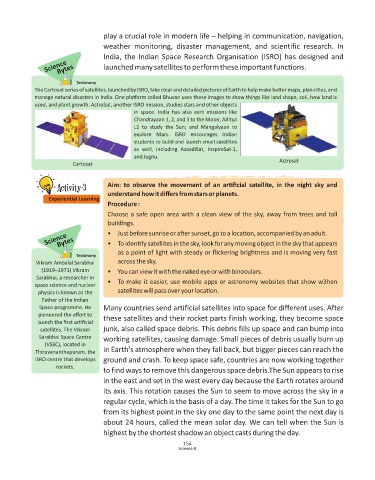
             The Cartosat series of satellites, launched by ISRO, take clear and detailed pictures of Earth to help make be er maps, plan ci es, and
             manage natural disasters in India. One pla orm called Bhuvan uses these images to show things like land shape, soil, how land is
             used, and plant growth. AstroSat, another ISRO mission, studies stars and other objects
                                               in  space.  India  has  also  sent  missions  like
                                               Chandrayaan 1, 2, and 3 to the Moon; Aditya
                                               L1  to  study  the  Sun;  and  Mangalyaan  to
                                               explore  Mars.  ISRO  encourages  Indian
                                               students to build and launch small satellites
                                               as  well,  including  AzaadiSat,  InspireSat-1,
                                               and Jugnu.
                                                                                                  Astrosat
                          Cartosat


                     Activity-3       Aim:  to  observe  the  movement  of  an  ar ficial  satellite,  in  the  night  sky  and
                                      understand how it differs from stars or planets.
                  Experiential Learning
                                      Procedure :

                                      Choose a safe open area with a clean view of the sky, away from trees and tall
                                      buildings.
                 Science              •  Just before sunrise or a er sunset, go to a loca on, accompanied by an adult.
                     Bytes
                                      •  To iden fy satellites in the sky, look for any moving object in the sky that appears
                                          as a point of light with steady or flickering brightness and is moving very fast
                           Testimony
             Vikram Ambalal Sarabhai      across the sky.
               (1919–1971) Vikram     •  You can view it with the naked eye or with binoculars.
              Sarabhai, a researcher in
             space science and nuclear   •  To make it easier, use mobile apps or astronomy websites that show w3hen
              physics is known as the     satellites will pass over your loca on.
                Father of the Indian
               Space programme. He   Many countries send artificial satellites into space for different uses. After
              pioneered the effort to   these satellites and their rocket parts finish working, they become space
              launch the first ar ficial
               satellites. The Vikram   junk, also called space debris. This debris fills up space and can bump into
               Sarabhai Space Centre   working satellites, causing damage. Small pieces of debris usually burn up
                 (VSSC), located in
             Thiruvananthapuram, the   in Earth's atmosphere when they fall back, but bigger pieces can reach the
             ISRO centre that develops   ground and crash. To keep space safe, countries are now working together
                    rockets.
                                     to find ways to remove this dangerous space debris.The Sun appears to rise
                                     in the east and set in the west every day because the Earth rotates around

                                     its axis. This rotation causes the Sun to seem to move across the sky in a
                                     regular cycle, which is the basis of a day. The time it takes for the Sun to go
                                     from its highest point in the sky one day to the same point the next day is
                                     about 24 hours, called the mean solar day. We can tell when the Sun is
                                     highest by the shortest shadow an object casts during the day.

                                                                154
                                                               Science-8

