


Page 153 - Innovator's Science-8
P. 153
Some festivals in India, like Makar Sankranti, Pongal, Bihu, Vaisakhi, Poila

                 Science             Baisakh,  and  Puthandu,  are  based  on  a  solar  sidereal  calendar.  These
                     Bytes
                                     festivals usually happen on about the same date every year in the Gregorian
                                     calendar, which is based on the tropical year. A long time ago, these festivals
                           Testimony
               Makar Snankran  is a   were linked to the solstices or equinoxes, which are specific points in the
               Hindu fes val which is   Earth's orbit around the Sun. However, because the sidereal and tropical
                celebrated on 14th
             January every year. In this   years are slightly different, the dates of these festivals slowly change over
              fes val, we observe the   time. This happens because of the slow wobble of the Earth's axis, kind of
             transi on of the Sun into
                    capricorn.       like how a spinning top wobbles. As a result, the dates of festivals based on
                                     the sidereal calendar move forward in the tropical calendar. For example,

                                     Makar Sankranti shifts ahead by about one day every 71 years.
                                     Many Indian festivals are celebrated based on the exact phase of the Moon
                                     at sunrise. Because sunrise happens earlier in Eastern India and later in

                                     Western India, the festival dates can shift by a day between these regions,
                                     even in the same year. To keep the dates uniform across the whole country,
                                     the Positional Astronomy Center of the Government of India publishes the
                                     Rashtriya Panchang every year. This book contains detailed calculations of

                                     the positions of celestial bodies like the Moon and the Sun for a central
                                     location in India. Using this information, the government receives advance
                                     notice of festival dates to declare official holidays.

                                     The Moon and moonlight have inspired many parts of Indian classical music
                                     and  art.  Some  ragas,  like  Chandrakauns,  Chandranandan,  and
                                     Shubhapantuvarali (which means "auspicious moon"), are named after the

                                     Moon and express its beauty through their melodies. In Indian classical
                                     dance forms like Bharatanatyam, hand gestures called mudras             , such as
                                                 Chandrakala and Ardhachandran, represent the Moon. Other
                                                 dance  styles  like  Kathak,  Odissi,  and  Kuchipudi  also  include
                                                 moon-related gestures. Traditional Indian art, including painting

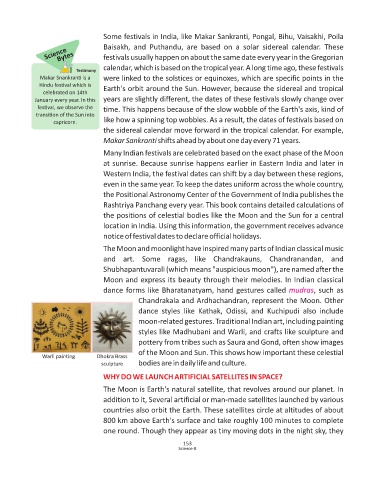
                                                 styles like Madhubani and Warli, and crafts like sculpture and
                                                 pottery from tribes such as Saura and Gond, often show images
                                                 of the Moon and Sun. This shows how important these celestial
                Warli painting     Dhokra Brass
                                    sculpture    bodies are in daily life and culture.
                                     WHY DO WE LAUNCH ARTIFICIAL SATELLITES IN SPACE?

                                     The Moon is Earth's natural satellite, that revolves around our planet. In
                                     addition to it, Several artificial or man-made satellites launched by various

                                     countries also orbit the Earth. These satellites circle at altitudes of about
                                     800 km above Earth's surface and take roughly 100 minutes to complete
                                     one round. Though they appear as tiny moving dots in the night sky, they

                                                                153
                                                               Science-8

