


Page 149 - Innovator's Science-8
P. 149
•  Find the duration of the solar day by finding a difference in time on two
                                        consecutive days as shown in the first column. Fill in the other enteries

                                        on your own.
                                                             Finding the dura on of a solar day
                                           Date         Time of shortest shadow (hh:mm)      Dura on of day (hh:mm)

                                      22 March 2025                   12:20                           ______
                                      23 March 2025                   12:20                           ______

                                      24 March 2025                  ______                           ______


                                     Calculate the average duration of the day. Is it almost equal to 24 hours?
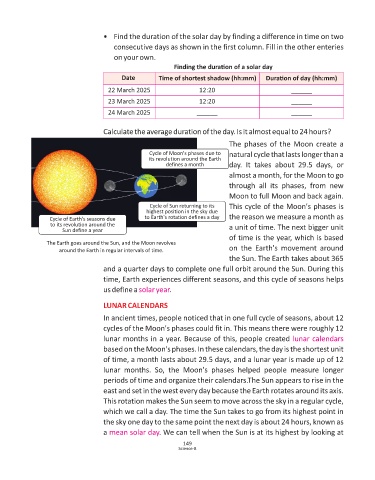
                                                                                The phases of the Moon create a
                                                     Cycle of Moon's phases due to  natural cycle that lasts longer than a
                                                     its revolution around the Earth
                                                          defines a month       day.  It  takes  about  29.5  days,  or
                                                                                almost a month, for the Moon to go
                                                                                through  all  its  phases,  from  new

                                                                                Moon to full Moon and back again.
                                                     Cycle of Sun returning to its  This cycle of the Moon's phases is
                                                    highest position in the sky due
                  Cycle of Earth's seasons due     to Earth's rotation defines a day  the reason we measure a month as
                  to its revolution around the                                  a unit of time. The next bigger unit
                       Sun define a year
                                                                                of time is the year, which is based
                 The Earth goes around the Sun, and the Moon revolves
                     around the Earth in regular intervals of time.             on  the  Earth's  movement  around
                                                                                the Sun. The Earth takes about 365
                                     and a quarter days to complete one full orbit around the Sun. During this

                                     time, Earth experiences different seasons, and this cycle of seasons helps
                                     us define a solar year .

                                     LUNAR CALENDARS

                                     In ancient times, people noticed that in one full cycle of seasons, about 12
                                     cycles of the Moon's phases could fit in. This means there were roughly 12
                                     lunar months in a year. Because of this, people created lunar calendars
                                     based on the Moon's phases. In these calendars, the day is the shortest unit

                                     of time, a month lasts about 29.5 days, and a lunar year is made up of 12
                                     lunar  months.  So,  the  Moon's  phases  helped  people  measure  longer
                                     periods of time and organize their calendars.The Sun appears to rise in the

                                     east and set in the west every day because the Earth rotates around its axis.
                                     This rotation makes the Sun seem to move across the sky in a regular cycle,
                                     which we call a day. The time the Sun takes to go from its highest point in
                                     the sky one day to the same point the next day is about 24 hours, known as
                                     a mean solar day   . We can tell when the Sun is at its highest by looking at

                                                                149
                                                               Science-8

