


Page 147 - Innovator's Science-8
P. 147
THE MOON'S CYCLE OF PHASES

                                     The Moon completes one full orbit around Earth in about 29.5 days. As it
                                     moves, we see it change from a full circle to a thin crescent and then
                                     disappear completely, only to grow again. The day on which the entire
                                     bright surface of the Moon is visible is called the Full Moon Day    , and the day
                 Science             it is not visible at all is called the New Moon Day .
                     Bytes
                                     From the New Moon to the Full Moon, the bright portion of the Moon
                           Testimony
                ‘Waxing’ means the   gradually increases - this period is called the waxing phase   .
               visible por on of the   From the Full Moon back to the New Moon, the bright part decreases - this
              moon is growing, while
                ‘waning’ means it is   period is called the waning phase .
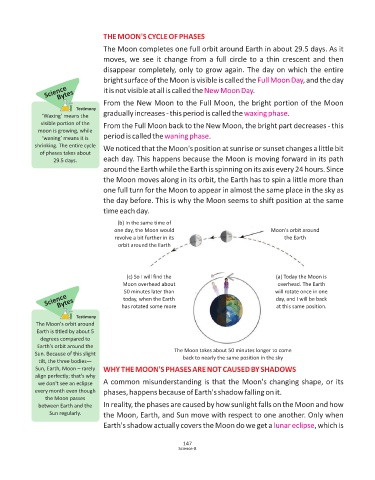
             shrinking. The en re cycle   We noticed that the Moon's position at sunrise or sunset changes a little bit
               of phases takes about
                    29.5 days.       each day. This happens because the Moon is moving forward in its path
                                     around the Earth while the Earth is spinning on its axis every 24 hours. Since
                                     the Moon moves along in its orbit, the Earth has to spin a little more than
                                     one full turn for the Moon to appear in almost the same place in the sky as
                                     the day before. This is why the Moon seems to shift position at the same

                                     time each day.

                                          (b) In the same time of
                                         one day, the Moon would                               Moon's orbit around
                                         revolve a bit further in its                              the Earth
                                          orbit around the Earth


                                             (c) So I will find the                             (a) Today the Moon is
                                           Moon overhead about                                   overhead. The Earth
                                            50 minutes later than                               will rotate once in one
                 Science                   has rotated some more                                day, and I will be back
                                            today, when the Earth
                     Bytes
                                                                                                 at this same position.
                           Testimony
             The Moon's orbit around
              Earth is  tled by about 5
               degrees compared to
              Earth's orbit around the
                                                             The Moon takes about 50 minutes longer το come
             Sun. Because of this slight
                                                                back to nearly the same position in the sky
               lt, the three bodies—
             Sun, Earth, Moon – rarely   WHY THE MOON'S PHASES ARE NOT CAUSED BY SHADOWS
             align perfectly; that's why
              we don't see an eclipse   A common misunderstanding is that the Moon's changing shape, or its
             every month even though   phases, happens because of Earth's shadow falling on it.
                 the Moon passes
              between Earth and the   In reality, the phases are caused by how sunlight falls on the Moon and how
                  Sun regularly.     the Moon, Earth, and Sun move with respect to one another. Only when

                                     Earth's shadow actually covers the Moon do we get a lunar eclipse        , which is


                                                                147
                                                               Science-8

