


Page 143 - Innovator's Science-8
P. 143
see from Earth slowly changes from day to day. These changes are known as
                                     the phases of the Moon. The Moon will appear bright and easy to find in the

                                     early morning sky. Observe it at the same time every day and note its
                                     position and shape.
                                     At first, the round full Moon appears large and bright. Gradually, it begins to

                                     shrink,  becoming  a  half-Moon,  then  a  narrow  crescent,  and  finally
                                     disappearing completely for a short while during the new Moon. After that,
                                     the bright portion starts to grow again-first as a thin crescent, then as a half-

                                     Moon, and once again as a full bright circle. This changing shape of the
                                     Moon  repeats  in  a  continuous  cycle  of  about  one  month,  helping  us
                                     understand that the Moon's appearance changes due to its motion around
                                     the Earth and the varving sunlight that falls upon it.


                     Activity-1       Aim: To observe the changing appearance and posi on of the Moon over several
                                      days and understand that these changes are caused by the Moon's movement
                  Experiential Learning
                                      around the Earth and the way sunlight falls on it.
                                      To understand how the Moon changes, you can start by spo ng it on the first day
                                      a er a full Moon. Look for it at sunrise in the western sky. Each day, record the date
                                      and the  me you saw it (sunrise or sunset). Draw a simple circle and shade the part
                                      that looks bright to show the
                                      Moon's shape. From the second day on, also note if the bright part is
                                      ge ng bigger or smaller compared to before, and whether the
                                      Moon seems closer to or farther from the Sun in the sky. A er about
                                      two  weeks,  you  might  not  see  the  Moon  at  sunrise  or  sunset
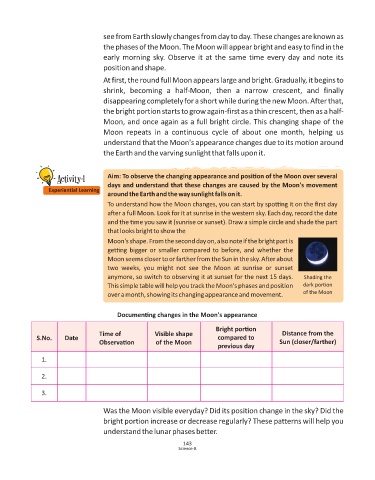
                                      anymore, so switch to observing it at sunset for the next 15 days.   Shading the
                                      This simple table will help you track the Moon's phases and posi on   dark portion
                                      over a month, showing its changing appearance and movement.         of the Moon


                                          Documen ng changes in the Moon's appearance

                                                                            Bright por on
                                   Time of             Visible shape                               Distance from the
              S.No.    Date                                                 compared to
                                   Observa on          of the Moon                                Sun (closer/farther)
                                                                            previous day

               1.

               2.


               3.


                                     Was the Moon visible everyday? Did its position change in the sky? Did the
                                     bright portion increase or decrease regularly? These patterns will help you
                                     understand the lunar phases better.

                                                                143
                                                               Science-8

