


Page 145 - Innovator's Science-8
P. 145
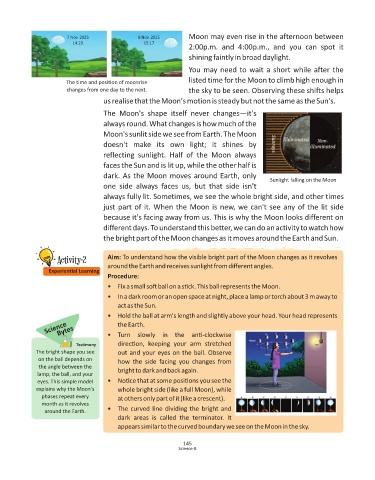
7 Nov. 2025              8 Nov. 2025      Moon may even rise in the afternoon between
                          14:23                    15:17
                                                                  2:00p.m.  and  4:00p.m.,  and  you  can  spot  it
                                                                  shining faintly in broad daylight.
                                                                  You may need to wait a short while after the

                        The time and position of moonrise         listed time for the Moon to climb high enough in
                        changes from one day to the next.         the sky to be seen. Observing these shifts helps
                                     us realise that the Moon's motion is steady but not the same as the Sun's.

                                     The  Moon's  shape  itself  never  changes—it's
                                     always round. What changes is how much of the
                                     Moon's sunlit side we see from Earth. The Moon
                                     doesn't  make  its  own  light;  it  shines  by

                                     reflecting  sunlight.  Half  of  the  Moon  always
                                     faces the Sun and is lit up, while the other half is
                                     dark. As the Moon moves around Earth, only
                                                                                              Sunlight falling on the Moon
                                     one  side  always  faces  us,  but  that  side  isn't

                                     always fully lit. Sometimes, we see the whole bright side, and other times
                                     just part of it. When the Moon is new, we can't see any of the lit side
                                     because it's facing away from us. This is why the Moon looks different on
                                     different days. To understand this better, we can do an activity to watch how

                                     the bright part of the Moon changes as it moves around the Earth and Sun.


                     Activity-2       Aim: To understand how the visible bright part of the Moon changes as it revolves
                                      around the Earth and receives sunlight from different angles.
                  Experiential Learning
                                      Procedure:
                                      •  Fix a small so  ball on a s ck. This ball represents the Moon.
                                      •  In a dark room or an open space at night, place a lamp or torch about 3 m away to
                                          act as the Sun.
                                      •  Hold the ball at arm's length and slightly above your head. Your head represents
                 Science              •  Turn  slowly  in  the  an -clockwise
                                          the Earth.
                     Bytes
                                                                                       Moon
                           Testimony      direc on,  keeping  your  arm  stretched                            Sun
             The bright shape you see     out and your eyes on the ball. Observe             Earth
              on the ball depends on      how  the  side  facing  you  changes  from
              the angle between the       bright to dark and back again.
              lamp, the ball, and your
              eyes. This simple model   •  No ce that at some posi ons you see the
              explains why the Moon's     whole bright side (like a full Moon), while
               phases repeat every        at others only part of it (like a crescent).
               month as it revolves
                around the Earth.     •  The curved line dividing the bright and
                                          dark  areas  is  called  the  terminator.  It
                                          appears similar to the curved boundary we see on the Moon in the sky.


                                                                145
                                                               Science-8

