


Page 148 - Innovator's Science-8
P. 148
Position
                                                                  Earth's orbit  favourable for
                                                                  around Sun   eclipses  Lunar eclipse at
                                                      Moon's slightly                    this position  No eclipses
                                                        titled orbit
                                                       around Earth                                 on these full
                                                                                                      and new
                                                                                                     Moon days
                                                                                    Solar eclipse
                                                                                     at these
                                                       No eclipses                   positions
                 Science                              on these full
                     Bytes
                                                        and new
                                                       Moon days
                                                                        Position
                           Testimony                                  favourable for
             •  The word eclipse comes                                  eclipses   Lunar eclipse at
                                                                                    this position
                from  the  Greek  word
                ekleipsis  which  means
                ‘being abandoned’.   quitedifferent from the regular phases.
             •  There  are  3  types  of
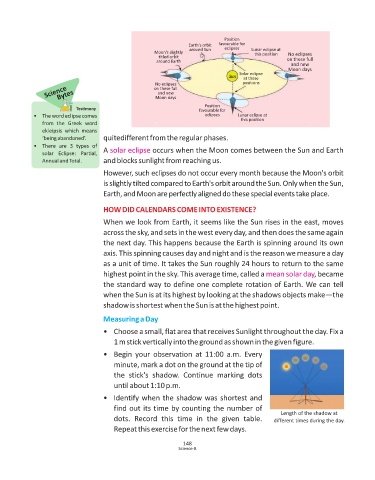
                solar  Eclipse:  Par al,   A solar eclipse  occurs when the Moon comes between the Sun and Earth
                Annual and Total.    and blocks sunlight from reaching us.
                                     However, such eclipses do not occur every month because the Moon's orbit

                                     is slightly tilted compared to Earth's orbit around the Sun. Only when the Sun,
                                     Earth, and Moon are perfectly aligned do these special events take place.

                                     HOW DID CALENDARS COME INTO EXISTENCE?

                                     When we look from Earth, it seems like the Sun rises in the east, moves
                                     across the sky, and sets in the west every day, and then does the same again

                                     the next day. This happens because the Earth is spinning around its own
                                     axis. This spinning causes day and night and is the reason we measure a day
                                     as a unit of time. It takes the Sun roughly 24 hours to return to the same
                                     highest point in the sky. This average time, called a mean solar day     , became
                                     the standard way to define one complete rotation of Earth. We can tell

                                     when the Sun is at its highest by looking at the shadows objects make—the
                                     shadow is shortest when the Sun is at the highest point.

                                     Measuring a Day

                                     •  Choose a small, flat area that receives Sunlight throughout the day. Fix a
                                        1 m stick vertically into the ground as shown in the given figure.

                                     •  Begin  your  observation  at  11:00  a.m.  Every
                                        minute, mark a dot on the ground at the tip of
                                        the  stick's  shadow.  Continue  marking  dots
                                        until about 1:10 p.m.

                                     •  Identify when the shadow was shortest and
                                        find out its time by counting the number of
                                                                                                  Length of the shadow at
                                        dots.  Record  this  time  in  the  given  table.       different times during the day.
                                        Repeat this exercise for the next few days.

                                                                148
                                                               Science-8

