


Page 156 - Innovator's Science-8
P. 156
NCERT Textbook Questions (Solved)


            Let Us Enhance Our Learning
              1.   State whether the following statements are True or False.

                   i.  We can only see that part of the Moon which reflects sunlight towards us.
                   ii.  The shadow of Earth blocks sunlight from reaching the Moon, causing phases.
                   iii. Calendars are based on various astronomical cycles which repeat predictably.
                   iv. The Moon can only be seen at night.
              Ans.  i. True, ii. False, iii. True,  iv. False
              2.   Amol was born on the 6th of May on a full Moon day. Does his birthday fall on the full Moon day every
                   year? Explain your answer.
              Ans.  No, Amol’s birthday doesn’t fall on a full Moon Day every year because the Moon’s phases follow a
                   different cycle than our calendar. The Moon goes through its phases in about 29.5 days, while a year on
                   our calendar is based on the Sun’s cycle, which is about 365 days. Since these two cycles don’t match up
                   perfectly, the date of the full Moon shi s from year to year in the Gregorian calendar, meaning it only
                   some mes lines up with Amol’s birthday.

              3.   Name two things that are incorrect in the Figure.
              Ans.  Two incorrect things are:
                   •  Stars are shown near the Moon during the day me, which is
                      incorrect because stars are not visible in the day me sky.
                   •  The Moon's dark part is shaded incorrectly to show a phase.
                      The shadow in the figure suggests it's caused by Earth's
                      shadow, which is not true for regular Moon phases; they are
                      caused by the Moon's posi on rela ve to the Earth and
                      Sun, not a shadow.
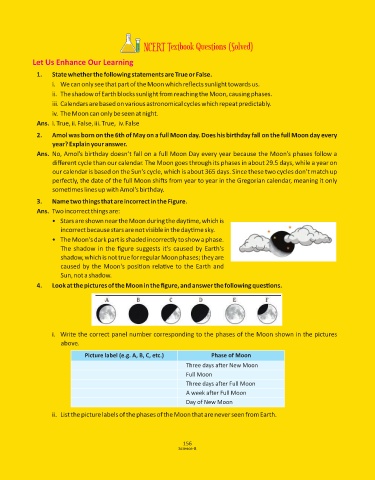
              4.   Look at the pictures of the Moon in the figure, and answer the following ques ons.


                   i.  Write the correct panel number corresponding to the phases of the Moon shown in the pictures
                      above.

                              Picture label (e.g. A, B, C, etc.)          Phase of Moon
                                                                 Three days after New Moon
                                                                 Full Moon
                                                                 Three days after Full Moon
                                                                 A week after Full Moon
                                                                 Day of New Moon

                   ii.  List the picture labels of the phases of the Moon that are never seen from Earth.


                                                                156
                                                               Science-8

