


Page 161 - Innovator's Science-8
P. 161
forests shrink and dry up, making them less capable of supporting the
                                     animals that live there. Elephants, which are naturally suited to forest life,

                                     struggle to survive when their environment changes too quickly To help
                                     animals  move  safely  between  forested  regions,  wildlife  experts  have
                                     identified and marked specific routes known as corridors. These corridors
                                     connect different parts of the forest, allowing animals like elephants to

                                     travel without entering human settlements and creating conflict.
                                     This series of events shows how closely all parts of nature are linked. To
                Elephants passing
                 through freely a    understand how nature maintains its balance, it is essential to study the
                  forest corridor
                                     different components of our environment.

                                     HOW DO WE EXPERIENCE AND UNDERSTAND OUR SURROUNDINGS?

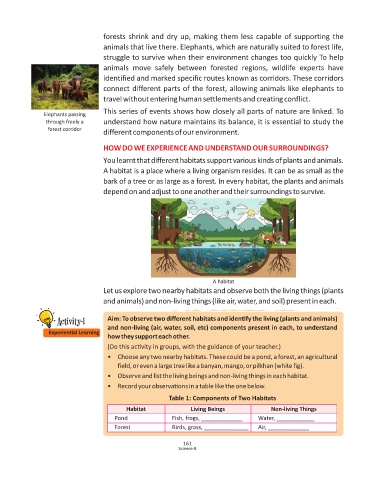
                                     You learnt that different habitats support various kinds of plants and animals.
                                     A habitat is a place where a living organism resides. It can be as small as the
                                     bark of a tree or as large as a forest. In every habitat, the plants and animals
                                     depend on and adjust to one another and their surroundings to survive.


                                                                           A habitat
                                     Let us explore two nearby habitats and observe both the living things (plants
                                     and animals) and non-living things (like air, water, and soil) present in each.


                     Activity-1       Aim: To observe two different habitats and iden fy the living (plants and animals)
                                      and non-living (air, water, soil, etc) components present in each, to understand
                  Experiential Learning
                                      how they support each other.
                                      (Do this ac vity in groups, with the guidance of your teacher.)
                                      •  Choose any two nearby habitats. These could be a pond, a forest, an agricultural
                                          field, or even a large tree like a banyan, mango, or pilkhan (white fig).
                                      •  Observe and list the living beings and non-living things in each habitat.

                                      •  Record your observa ons in a table like the one below.
                                                           Table 1: Components of Two Habitats

                                             Habitat               Living Beings               Non-living Things
                                         Pond               Fish, frogs, _____________    Water, ____________
                                         Forest             Birds, grass, ______________  Air, _____________

                                                                161
                                                               Science-8

