


Page 166 - Innovator's Science-8
P. 166
Living organisms also interact with one another. This include getting food,
                                     breathing, and reproducing. So, both kinds of interactions between living

                                     organisms and between living and non-living components – are important
                                     for survival in any habitat.


                                        Match the following:
                      Run Through
                                        1.  Community               a.  A place where organisms live
               Intellectual Development
                                        2.  Habitat                 b.  All living things like plants, animals, microbes
                                        3.  Abiotic                 c.  Different populations living together
                                        4.  Population              d.  Non-living parts like air, water, soil, sunlight
                                        5.  Biotic                  e.  Same kind of organisms living together


                                     What is an Ecosystems?
                                     An ecosystem includes all the living organisms and non-living elements of a
                                     habitat and how they interact. Organisms rely on non-living components

                                     for food, shelter, and protection. In every ecosystem, communities of living
                                     organisms interact closely with non-living factors.

                                     There are two major types of ecosystems:
                                     •  Aquatic ecosystems: These include ponds, rivers, and lakes.
                                     •  Terrestrial  ecosystems:  These  include  forests,  farms,  grasslands  and

                                        even a single large tree like a banyan or mango tree.
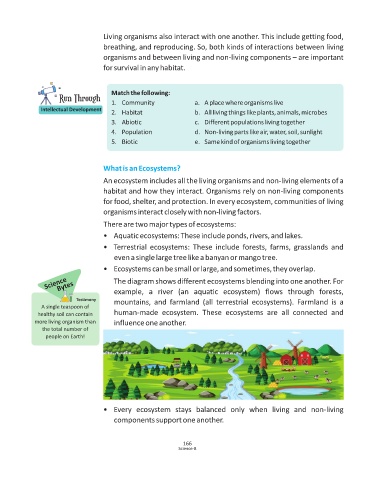
                                     •  Ecosystems can be small or large, and sometimes, they overlap.
                 Science                The diagram shows different ecosystems blending into one another. For
                     Bytes


                           Testimony    example,  a  river  (an  aquatic  ecosystem)  flows  through  forests,
                                        mountains,  and  farmland  (all  terrestrial  ecosystems).  Farmland  is  a
               A single teaspoon of
              healthy soil can contain   human-made  ecosystem.  These  ecosystems  are  all  connected  and
             more living organism than   influence one another.
                the total number of
                 people on Earth!


                                     •  Every  ecosystem  stays  balanced  only  when  living  and  non-living
                                        components support one another.


                                                                166
                                                               Science-8

