


Page 167 - Innovator's Science-8
P. 167
How Components Depend on Each Other

                                     •  Plants need sunlight, water, carbon dioxide, and soil nutrients to make
                                        food.
                                     •  Soil provides support and minerals for plant growth.

                                     •  Air contains oxygen needed by both plants and animals for breathing.
                                     •  Water is necessary for all living beings.

                                     This shows how biotic components depend on abiotic components.
                                     But the relationship goes both ways. Abiotic components also rely on biotic

                                     components.
                                     •  Plants release oxygen into the air during photosynthesis.

                                     •  Roots of plants hold the soil together and prevent erosion.
                                     •  Plants help retain moisture in the soil and keep the air cool.


                     Activity-4       Look around your surroundings and identify any ecosystem-whether it's a garden,
                                      pond, or forested area. Observe the interactions between living and non-living
                  Experiential Learning
                                      components, and notice how organisms depend on one another, especially for food
                                      and survival.


                                     Plants prepare their own food through a process called photosynthesis             ,
                                     using sunlight, carbon dioxide, and water. Because they make their own
                                     food, they are known as producers      or autotrophs   (auto = self, troph = food).

                                     Organisms that cannot make their own food and rely on other living things
                                     are called consumers    or heterotrophs   (hetero = other, troph = food).


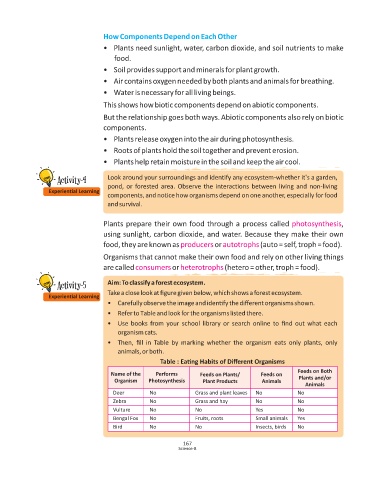
                     Activity-5       Aim: To classify a forest ecosystem.
                                      Take a close look at figure given below, which shows a forest ecosystem.
                  Experiential Learning
                                      •  Carefully observe the image and iden fy the different organisms shown.
                                      •  Refer to Table and look for the organisms listed there.
                                      •  Use books from your school library or search online to find out what each
                                          organism cats.
                                      •  Then,  fill  in  Table  by  marking  whether  the  organism  eats  only  plants,  only
                                          animals, or both.
                                                        Table : Ea ng Habits of Different Organisms

                                                                                                        Feeds on Both
                                       Name of the     Performs       Feeds on Plants/     Feeds on
                                         Organism   Photosynthesis     Plant Products       Animals     Plants and/or
                                                                                                           Animals
                                        Deer         No             Grass and plant leaves  No          No
                                        Zebra        No             Grass and hay        No             No
                                        Vulture      No             No                   Yes            No
                                        Bengal Fox   No             Fruits, roots        Small animals   Yes
                                        Bird         No             No                   Insects, birds  No

                                                                167
                                                               Science-8

